


We are unpacking content from Bali Business Review on YouTube to examine why Bali flight volumes have fallen to a three-year low, with roughly 50 fewer daily flights. Early-2026 data points to a measurable dip tied to geopolitical airspace disruptions and cooling travel demand, but the numbers may signal normalization rather than market collapse.
Hi, I’m Jason, a Business Journalist at Bukit Vista, and I’ll be unpacking analysis from Bali Business Review. Today, we’ll dive into Bali flight normalization and villa market implications to offer clear, data-driven insights.
Flight Volume Data: The Numbers Behind the Bali Flights Drop

Airline schedules and airport throughput show Bali at its lowest daily flight count in three years, with approximately 50 fewer flights each day compared to peak post-pandemic levels. This reduction is visible across international and regional routes and is reflected in lower seat capacity and fewer arrivals per day, which directly affects short-term tourism inflows and airport-based revenue streams.
For SEO-minded readers, key search terms to track include Bali flights drop, flight volumes Bali 2026, and Bali airport traffic. These metrics help translate industry headlines into measurable KPIs for property owners assessing demand curves and occupancy projections.
What Could Your Bali Villa Really Earn?
Drivers: Geopolitical Airspace and Seasonal Cooling

Airspace restrictions and rerouted flight corridors following regional geopolitical events have compressed available slots and shifted airline capacity planning. Combined with the end of the intense post-pandemic rebound, airlines are trimming frequencies to match more conservative demand forecasts rather than maintaining inflated schedules.
Understanding whether disruptions are structural or temporary is critical. Villa owners and operators should monitor airline capacity reports and slot allocations to anticipate weekly occupancy fluctuations and adjust marketing and channel strategies accordingly.
Demand Shift: Normalization vs. Market Downturn

The early-2026 dip appears correlated with a normalization of travel patterns after extraordinary 2022–2024 growth. Instead of a systemic market crash, data suggests a reversion toward historical baselines for arrivals, with demand smoothing across seasons and source markets. This transition reduces speculative upside but improves predictability for long-term planning.
Keywords like Bali tourism normalization, travel demand Bali, and Bali arrivals 2026 are useful when researching comparative historical data. Owners should treat this phase as an opportunity to test resilience, not as an immediate signal to engage in aggressive price competition.
Villa Owner Impact: Pricing, Experience, and Retention
With fewer flights and lower transient demand, revenue-per-available-rental (RevPAR) pressure increases, but the correct response is strategic rather than reactive. Instead of across-the-board discounts, emphasis should shift to improving guest experience, loyalty, and direct-booking channels to protect margins and lifetime customer value.
Operational checklist for owners
- Audit distribution costs and reduce reliance on high-commission OTAs.
- Invest in guest retention: targeted email campaigns and loyalty incentives.
- Refine pricing by segment and length-of-stay rather than blanket reductions.
Valuation and Operational Efficiency
Now is the time to validate true property valuation against realistic revenue scenarios. Properties that optimized operations, reduced waste, and enhanced service quality will outperform peers in a normalized market. Accurate revenue projections and an honest cost baseline are essential to identify underperforming assets.
Actions to improve valuation
- Run a three-year revenue projection using current flight and arrival trends.
- Benchmark operational costs per booking and eliminate non-performing services.
- Prioritize upgrades that increase net operating income rather than headline ADR.
Key Takeaways
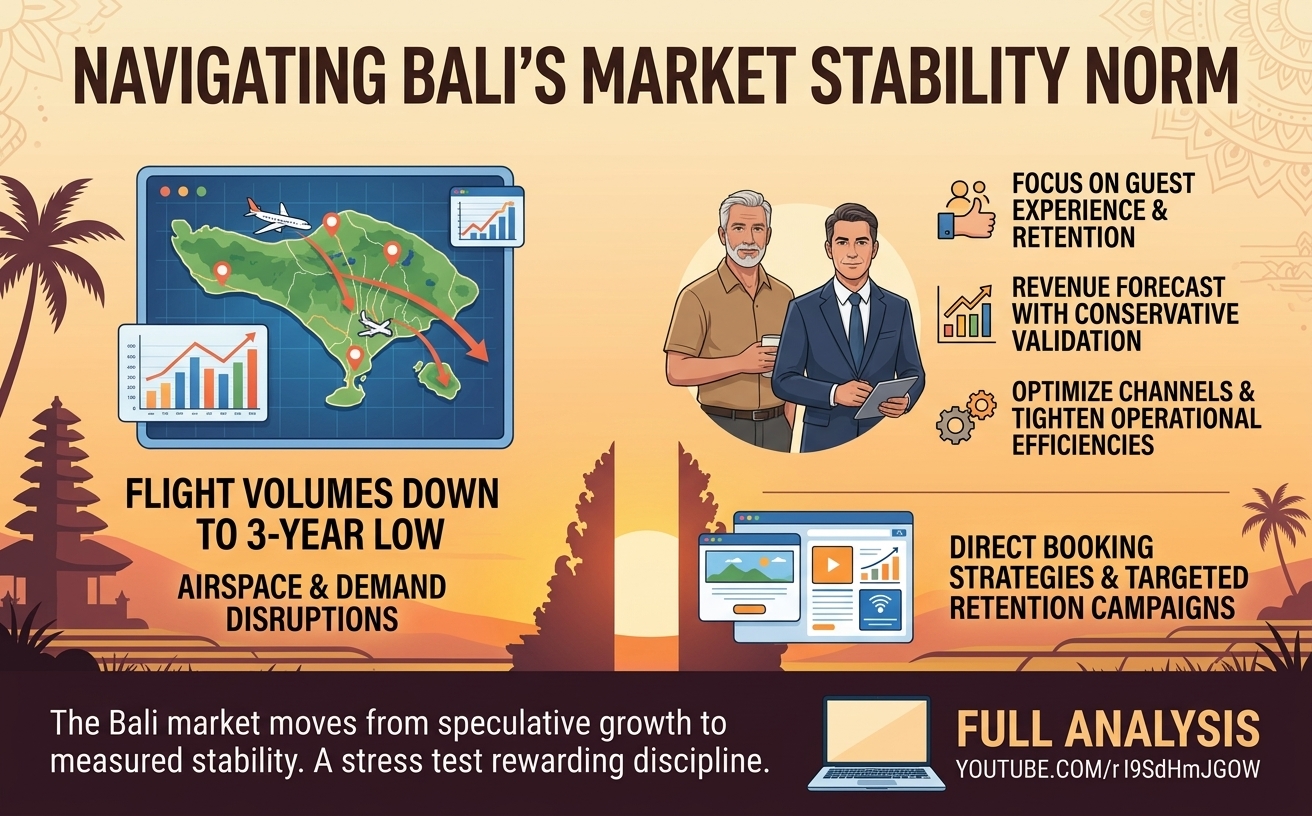
- Flight volumes in early 2026 are down to a three-year low, with ~50 fewer daily flights—track Bali flights drop and flight volumes Bali 2026 for context.
- Airspace disruptions and demand normalization are the primary drivers, suggesting predictability rather than systemic collapse.
- Villa owners should focus on guest experience, retention, and channel optimization instead of indiscriminate price cuts.
- Validate property valuation with conservative revenue forecasts and tighten operational inefficiencies to protect long-term ROI.
- Use direct-booking strategies and targeted retention campaigns to mitigate reduced transient arrivals.
Final word: the Bali market is moving from speculative growth to measured stability. For villa owners and investors, this is a stress test that rewards operational discipline, strategic pricing, and investment in guest retention. View the full analysis at https://www.youtube.com/embed/rI9SdHmJGOw and use this normalization phase to optimize for sustainable returns.
Jason, Business Journalist at Bukit Vista
Take the First Step to Joining Our Community, Book a Consultation with us Today!
At Bukit Vista, we believe in creating lasting partnerships that help navigate your property to the top 1% in this competitive season. Join us to discover how we can work together.
What Could Your Bali Villa Really Earn?
Get a data-driven revenue projection based on your property type, area, and bedroom count. Discover your villa’s true earning potential in Bali.