


Bali Real Estate: Avoid This Foolish Mistake and Maximise Your Villa Revenue
We are unpacking content from Bali Business Review on YouTube to highlight a common, costly mistake in Bali property investing that suppresses rental returns. Key data-driven points include occupancy shortfalls, pricing mismatches versus market comps, and the availability of a free Bali Property Revenue Calculator to quantify underperformance.
Hi, I’m Jason, a Business Journalist at Bukit Vista, and I’ll be unpacking analysis from Bali Business Review. Today, we’ll dive into avoiding common mistakes in Bali real estate to offer clear, data-driven insights.
Common Pitfalls That Undermine Bali Property Returns

Many Bali property owners overestimate the passive nature of villa investing and underestimate the gap between ownership expectations and operational reality. Typical pitfalls include relying on historical purchase assumptions, not benchmarking against current market rates, and ignoring direct operating metrics like seasonality-adjusted occupancy and average daily rate (ADR). These errors compound: a 10-20% occupancy shortfall or a mispriced nightly rate can translate to tens of thousands of dollars in lost annual revenue for a single villa.
Addressing the problem starts with objective measurement rather than intuition. Investors must adopt a disciplined approach to data: routinely compare monthly revenue figures to peer properties, factor in distribution fees and maintenance costs, and adjust pricing strategy for events, holidays, and long-stay demand. The actionable starting point highlighted is the Bali Property Revenue Calculator, which converts surface-level metrics into a clear revenue gap and recommended levers to improve performance.
Checklist: Immediate diagnostic steps for owners
- Collect 12 months of revenue and occupancy data: Establish a baseline by pulling nightly rates, bookings, cancellations, and occupancy percentages for the past year to see true seasonality patterns.
- Benchmark against comparable villas: Use location, bedroom count, and amenity set to compare ADR and occupancy—benchmarks reveal whether underperformance is market-wide or property-specific.
- Calculate net operating returns: Deduct management fees, cleaning, utilities, and marketing from gross rental revenue to understand actual cash flow.
- Identify booking channel mix: Determine what percentage of bookings comes from OTAs, direct channels, and management partners to optimize commission vs conversion trade-offs.
- Run the Bali Property Revenue Calculator: Input property type, area, and bedrooms at Bali Property Revenue Calculator for a quick revenue projection and gap analysis.
- Audit guest experience and amenities: Small upgrades like faster Wi-Fi, professional photography, and clearer house rules often lift occupancy and ADR substantially.
- Review tax and compliance impacts: Unexpected taxes or licensing gaps can reduce net returns—factor legal compliance into profitability scenarios.
- Monitor market supply changes: New developments or sudden inventory drops in neighboring areas shift pricing dynamics quickly; track permit filings and listings.
- Test dynamic pricing: Implement a demand-based pricing engine for peak vs low seasons to capture incremental revenue without losing occupancy.
- Set monthly KPI reviews: Establish owner-facing dashboards showing revenue per available room (RevPAR) and booking lead time to track improvements.
What Could Your Bali Villa Really Earn?
How to Use Revenue Data to Rescue Underperforming Properties
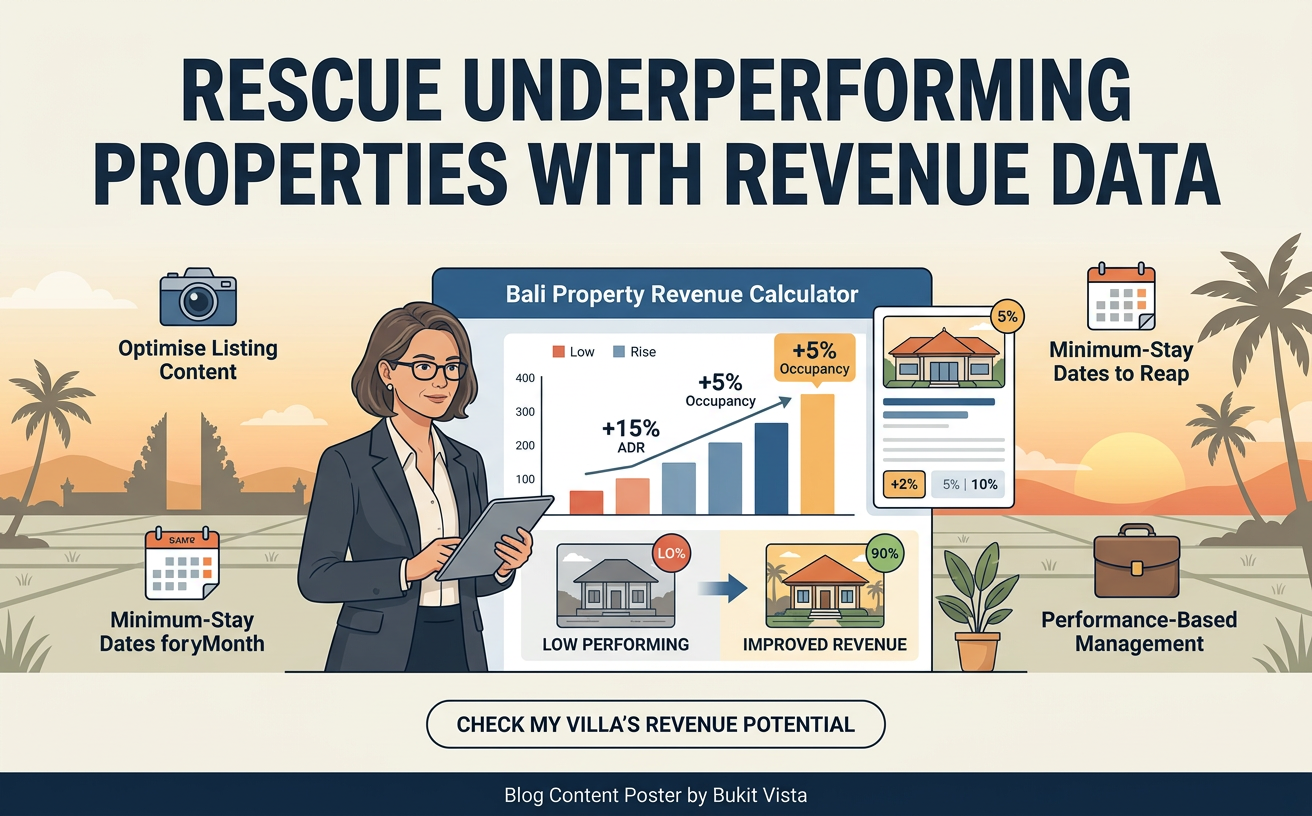
Rescuing a low-performing Bali property requires converting diagnostics into targeted interventions. Start by isolating the single largest drag on revenue—be it poor visibility, insufficient marketing spend, or mismatched nightly rates—and allocate resources to that priority. Small percentage improvements in ADR or occupancy compound rapidly: a 15% uplift in ADR coupled with a 5% occupancy increase can yield outsized ROI relative to modest renovation or distribution investments.
Operational fixes should be prioritized by payback period. Low-cost, high-impact measures include professional photography, optimized OTA listings with accurate amenities and clear cancellation policies, and targeted promotions for shoulder seasons. For owners open to management changes, consider performance-based partnerships that align manager incentives with revenue growth rather than occupancy alone. The calculator link and the embedded YouTube source Bali Revenue Management YouTube provide frameworks and examples that make it easier to model potential gains and decide where to invest next.
Checklist: Tactical revenue improvement actions
- Optimize listing content: Refresh titles, descriptions, and photos to highlight differentiators—private pools, proximity to attractions, or unique architecture—to increase click-through rates.
- Introduce minimum-stay and length-of-stay strategies: Use minimum nights during high demand and discounts for weekly/monthly stays during low season to stabilize cash flow.
- Refine cancellation policy: Balanced policies can improve booking confidence without deterring last-minute travelers; test soft vs strict policies by season.
- Invest in professional guest communication: Automated messaging for check-in, local recommendations, and upsell opportunities raises guest satisfaction and review scores.
- Implement targeted promotions: Use retargeting ads and segmented email campaigns for past guests and lookalike audiences to rebook and increase direct bookings.
- Audit pricing against events: Map local festivals, conferences, and school holidays to tighten pricing and prevent revenue leakage on high-demand dates.
- Negotiate distribution fees: Reassess OTA commission structures and prioritize high-converting channels to improve net ADR.
- Plan a staged renovation: Prioritize curb appeal, bedroom comfort, and bathroom upgrades that drive the largest ADR improvements per dollar spent.
- Measure monthly and iterate: Use the revenue calculator outputs and monthly KPIs to validate interventions and reallocate resources where they produce the best return.
- Consider professional management transitions: If internal operations consistently underperform, a performance-aligned manager can often unlock immediate upside through distribution and operational expertise.
Key Takeaways
- Measure first, act second: Use reliable 12-month data and the Bali Property Revenue Calculator to quantify underperformance before investing.
- Prioritise high-payback fixes: Photography, listing optimization, and dynamic pricing often deliver the fastest revenue lifts.
- Benchmark objectively: Compare ADR, occupancy, and RevPAR against true comps to identify specific gaps rather than broad assumptions.
- Align incentives: Performance-based management agreements and KPI-driven dashboards keep focus on net revenue growth.
- Iterate with monthly reviews: Small, consistent improvements compound rapidly—track outcomes and pivot where necessary.
Final word: Bali property investors who move from intuition to measurement unlock meaningful revenue improvements. By diagnosing the specific drivers of underperformance and applying prioritized, data-backed interventions—using tools like the Bali Property Revenue Calculator—owners can convert a struggling asset into a reliable revenue generator and protect long-term capital value.
Jason, Business Journalist at Bukit Vista
You’re a property owner? Wondering What Could Your Bali Villa Really Earn?
Get a data-driven revenue projection based on your property type, area, and bedroom count. Discover your villa’s true earning potential in Bali.