


Is This Beach Worth the Investment? How Bali Market Data and a Revenue Calculator Reveal True Returns

We are unpacking content from Bali Business Review on YouTube to determine whether a specific beachfront property delivers realistic returns. The report centers on market-derived assumptions and a free Bali Property Revenue Calculator that uses live data to estimate revenue and flag underperforming assets.
Hi, I’m Jason, a Business Journalist at Bukit Vista, and I’ll be unpacking analysis from Bali Business Review. Today, we’ll dive into whether a beachfront property is worth the investment to offer clear, data-driven insights.
What Could Your Bali Villa Really Earn?
How to Evaluate a Beachfront Property Investment

Evaluating a beachfront property starts with separating emotion from metrics. Location appeal and visual panoramas are important, but revenue-driven investors must prioritize occupancy trends, average daily rates (ADR), seasonality, and operating costs to determine realistic returns. A property that looks premium can still underperform if local demand, accessibility, or operating inefficiencies compress net income.
Begin by assembling a baseline financial model: projected ADR, expected occupancy rate by month, cleaning and maintenance, management fees, taxes, and capital expenditure reserves. Compare this baseline with comparable properties in the same micro-market to spot gaps. If your projections rely on optimistic occupancy or ADR without comparable market evidence, the asset is at higher risk of underperforming.
Checklist: First-pass Investment Filters
- Confirm ADR and occupancy benchmarks from nearby comparable listings
- Estimate fixed and variable operating costs, including utilities and staff
- Assess accessibility and transport links that influence demand
- Factor seasonality and local events that spike or depress bookings
Why Market Data Matters for Accurate Revenue Estimates
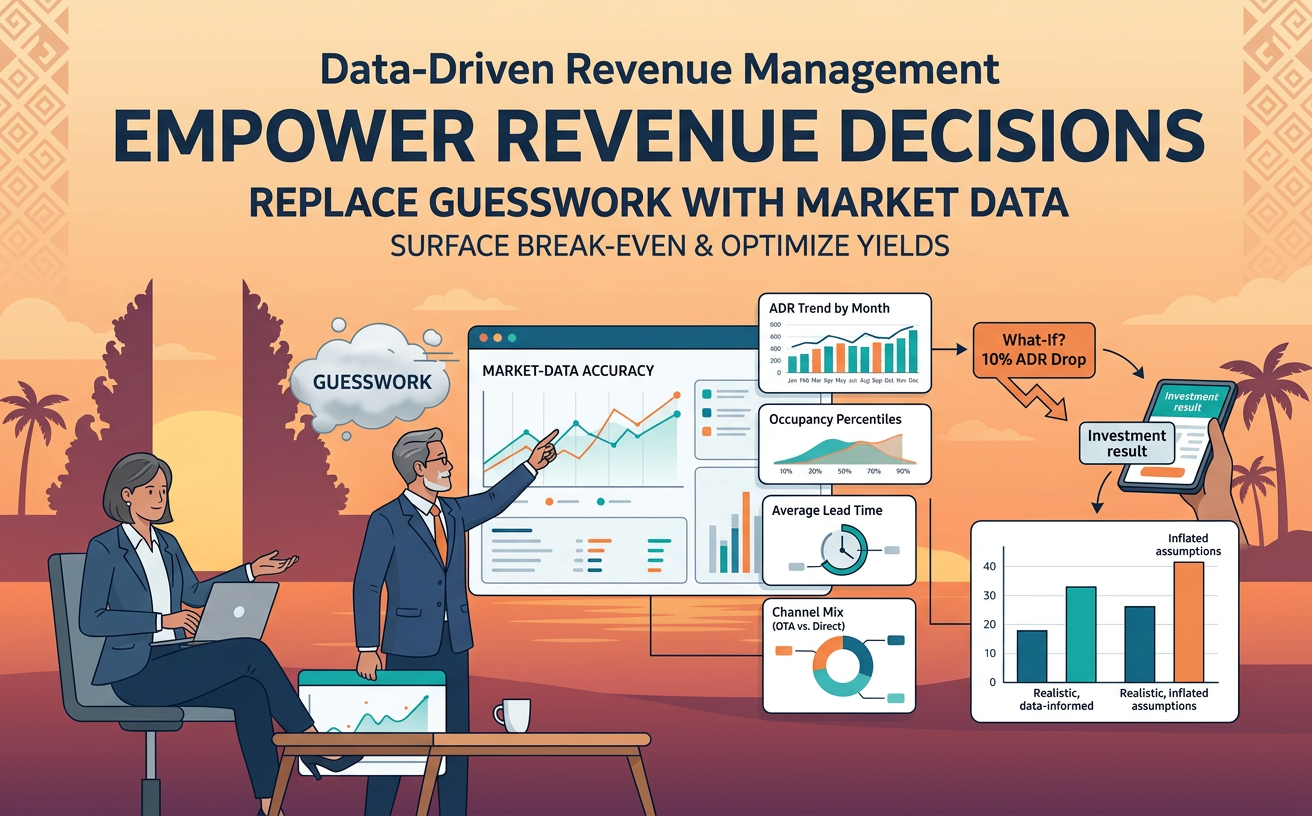
Market data replaces guesswork with evidence. Historical occupancy percentiles, ADR trends, booking lead times, and channel mix (OTA vs direct) inform realistic revenue projections. Without this data, investors risk using anecdotal or inflated assumptions that inflate expected returns and conceal downside scenarios.
Using up-to-date listings and transaction data also allows sensitivity testing — for example, how a 10% drop in ADR or a 15% fall in occupancy affects net operating income. This approach surfaces break-even points and stress-test scenarios, helping investors decide whether to buy, renegotiate price, or plan operational improvements to reach target yields.
Key data inputs to source
- Local ADR and occupancy by month
- Average length of stay and booking lead time
- Distribution of bookings across channels
- Comparable property fees and maintenance expenses
What Could Your Bali Villa Really Earn?
Using the Bali Property Revenue Calculator to Test Scenarios
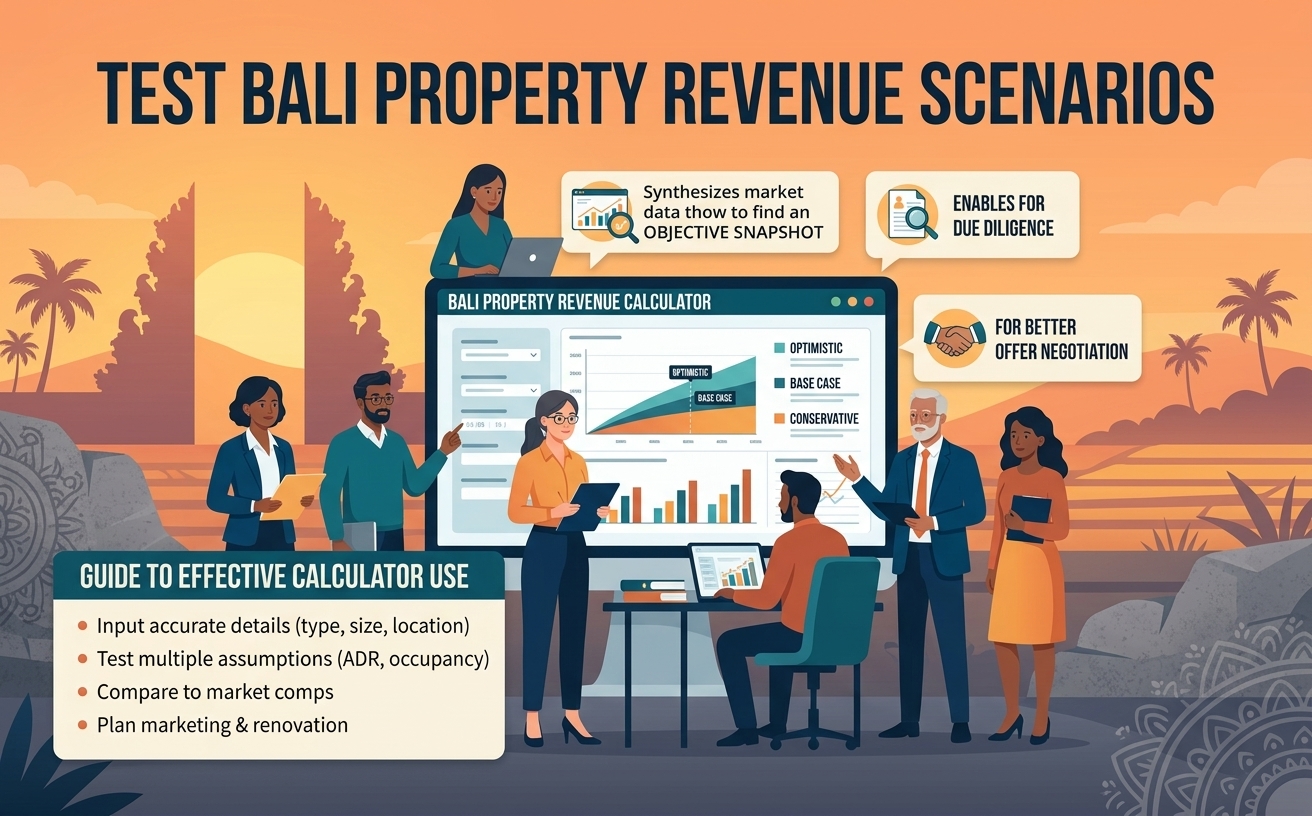
The Bali Property Revenue Calculator synthesizes market inputs into instant revenue and occupancy estimates, enabling rapid scenario analysis. By entering property type, location, and bedroom count, the calculator cross-references market data to indicate whether a property is likely underperforming or has room to improve. This objective snapshot helps investors prioritize due diligence or operational fixes before committing capital.
Run multiple scenarios — optimistic, base case, and conservative — to understand the range of potential returns and the impact of key variables. For a practical walkthrough of how the calculator applies market inputs to projection models, see the embedded walkthrough at this video. Using the tool before negotiation can also strengthen your offer or support requests for price adjustments based on projected performance.
How to use the calculator effectively
- Input accurate property attributes: type, size, and exact location
- Test multiple ADR and occupancy assumptions to create scenarios
- Compare calculator outputs against comparable properties you’ve researched
- Use results to guide offer price, renovation budgets, or marketing plans
Key Takeaways

- Rely on market data — ADR, occupancy, and comparable listings — not impressions, to assess beachfront investments.
- Stress-test assumptions with conservative scenarios to identify downside risks and breakeven thresholds.
- The Bali Property Revenue Calculator provides an evidence-based, instant projection to flag underperforming assets before purchase.
- Use calculator outputs to negotiate price, plan operational improvements, or decide against a poor-fit acquisition.
Final word: a beachfront property’s visual appeal must be balanced by rigorous, data-driven revenue projections. Using market inputs and tools like the Bali Property Revenue Calculator reduces investment risk and clarifies whether a property is a strategic buy or a value trap. Run the numbers first, then make the offer.
Jason, Business Journalist at Bukit Vista
You’re a property owner? Wondering What Could Your Bali Villa Really Earn?
Get a data-driven revenue projection based on your property type, area, and bedroom count. Discover your villa’s true earning potential in Bali.