

Hard vs Soft Infrastructure in Bali: Balancing Investments to Maximize Property Performance
Unpacking content from Bali Business Review on YouTube, this report distills the core facts and data linking Bali’s infrastructure mix to property performance. Key points include measurable gaps in roads and utilities, shortfalls in workforce skills and governance, and clear correlations between infrastructure quality and occupancy, ADR, and revenue potential.
Hi, I’m Jason, a Business Journalist at Bukit Vista, and I’ll be unpacking analysis from Bali Business Review. Today, we’ll dive into hard vs soft infrastructure in Bali and its impact on property performance to offer clear, data-driven insights.
Hard Infrastructure: Current State and Immediate Constraints
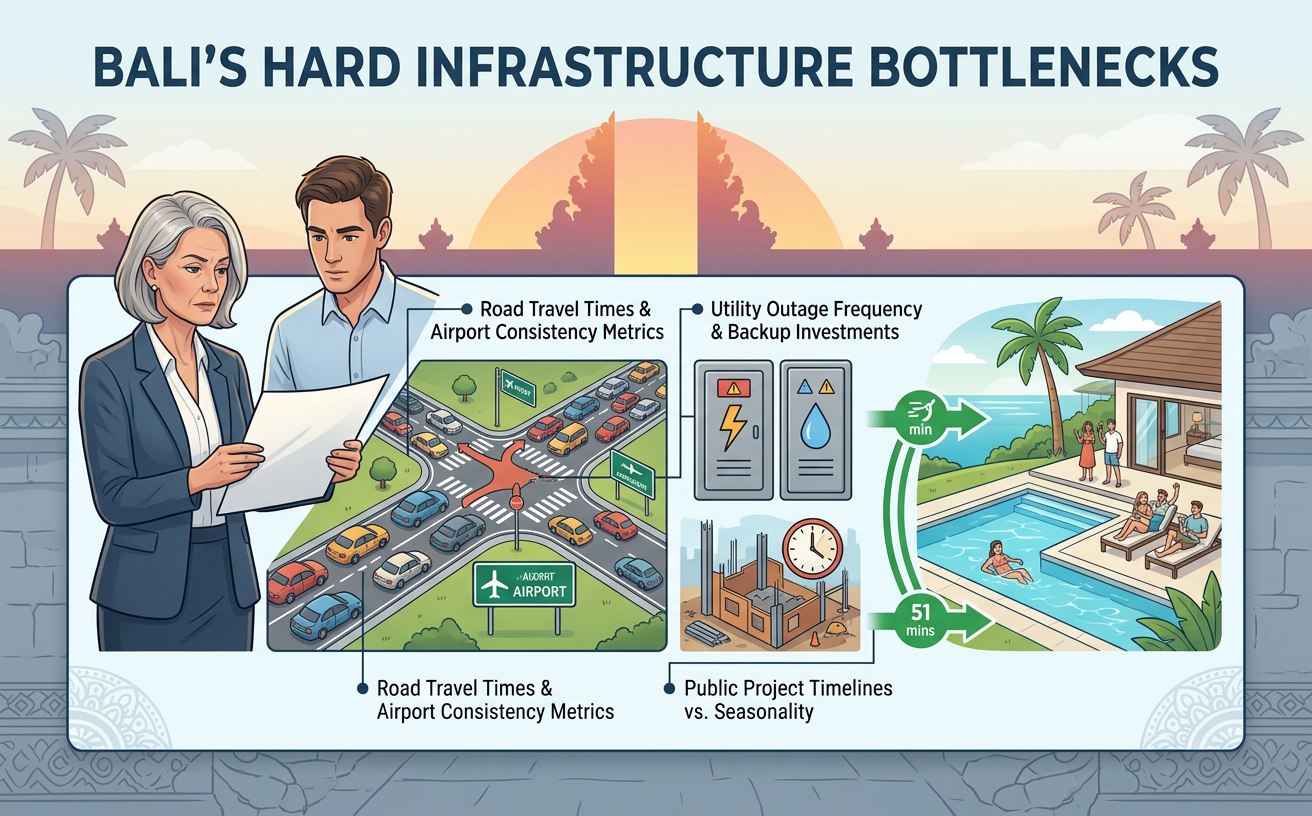
Bali’s hard infrastructure—roads, sewage, freshwater supply, airport capacity, and electrical grids—remains the immediate bottleneck for scalable tourism growth and reliable property operations. Congested access routes increase guest transfer times and reduce guest satisfaction scores, while inconsistent water and power supply raise operating costs for short-stay properties that must invest in backups. These physical deficits create measurable drag on occupancy and average daily rate (ADR) because guests compare commute convenience and amenity reliability across destinations.
Investment in hard assets yields visible short-term benefits for property performance: reduced maintenance overhead, higher guest reviews, and improved repeat-booking rates. However, heavy capital focus on hard projects without parallel improvements in services can produce limited returns; infrastructure projects must align with demand patterns and local capacity to be effective.
Concrete indicators to monitor
- Road travel times to main tourist hubs and airport consistency metrics
- Frequency of utility outages and on-site backup investments by properties
- Public project timelines vs. tourism seasonality impacts
What Could Your Bali Villa Really Earn?
Soft Infrastructure: Governance, Skills, and Service Quality
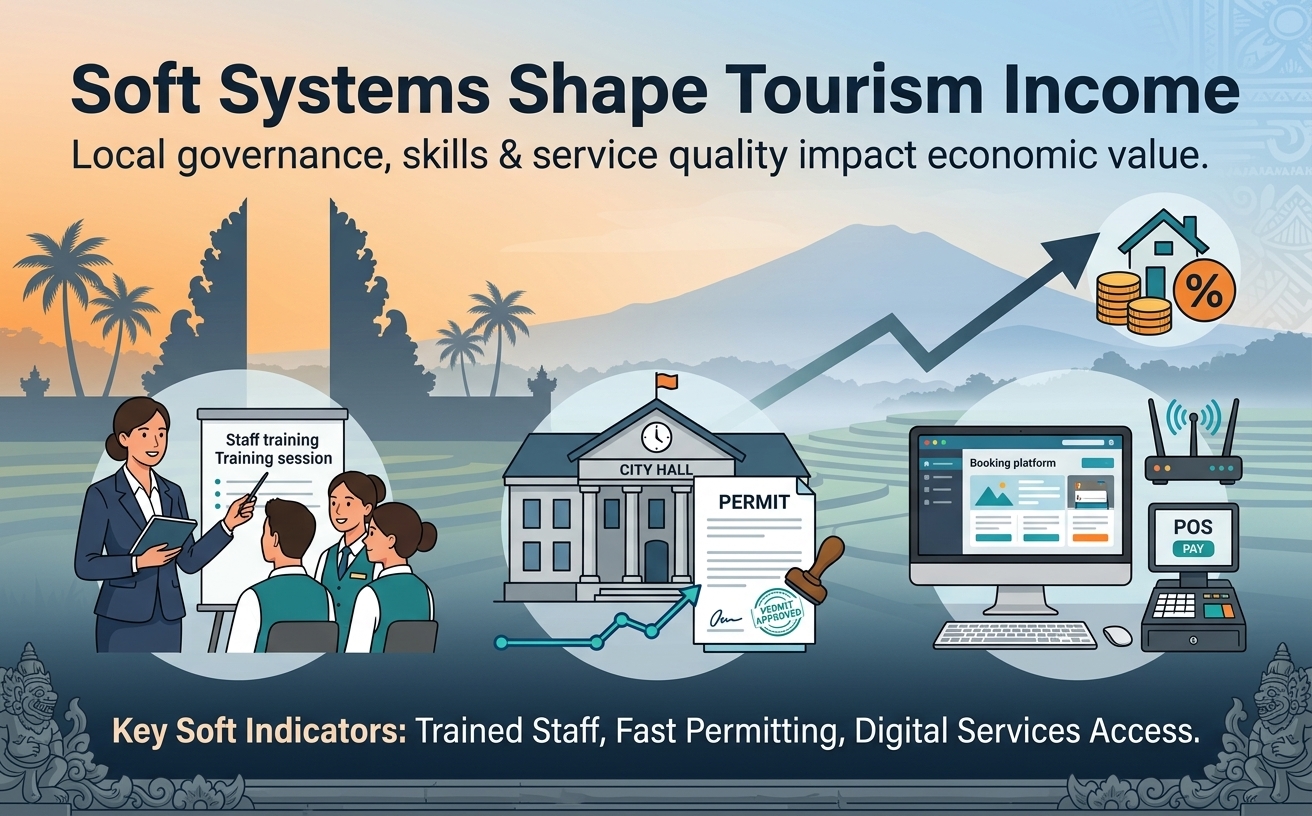
Soft infrastructure—local governance efficiency, regulatory clarity, workforce skills, hospitality training, and digital services—shapes how effectively hard assets translate into economic value. Bali’s tourism-dependent economy requires skilled local labor, standards for property management, and clear permitting to convert infrastructure into higher occupancy and yield. Gaps in training and governance increase operational friction and limit the ability of property operators to scale premium offerings.
Improvements in soft systems often have outsized, sustained effects on revenue because they enhance guest experience, lower compliance risk, and enable premium pricing through consistent service quality. For investors, soft infrastructure reduces variability in net operating income by stabilizing staffing, compliance timelines, and guest satisfaction metrics.
Priority soft indicators for operators
- Availability of trained hospitality staff and continuing education programs
- Speed and predictability of permitting and licensing processes
- Access to digital services: booking platforms, high-speed internet, and local fintech
How Infrastructure Mix Directly Impacts Property Revenue and Valuation
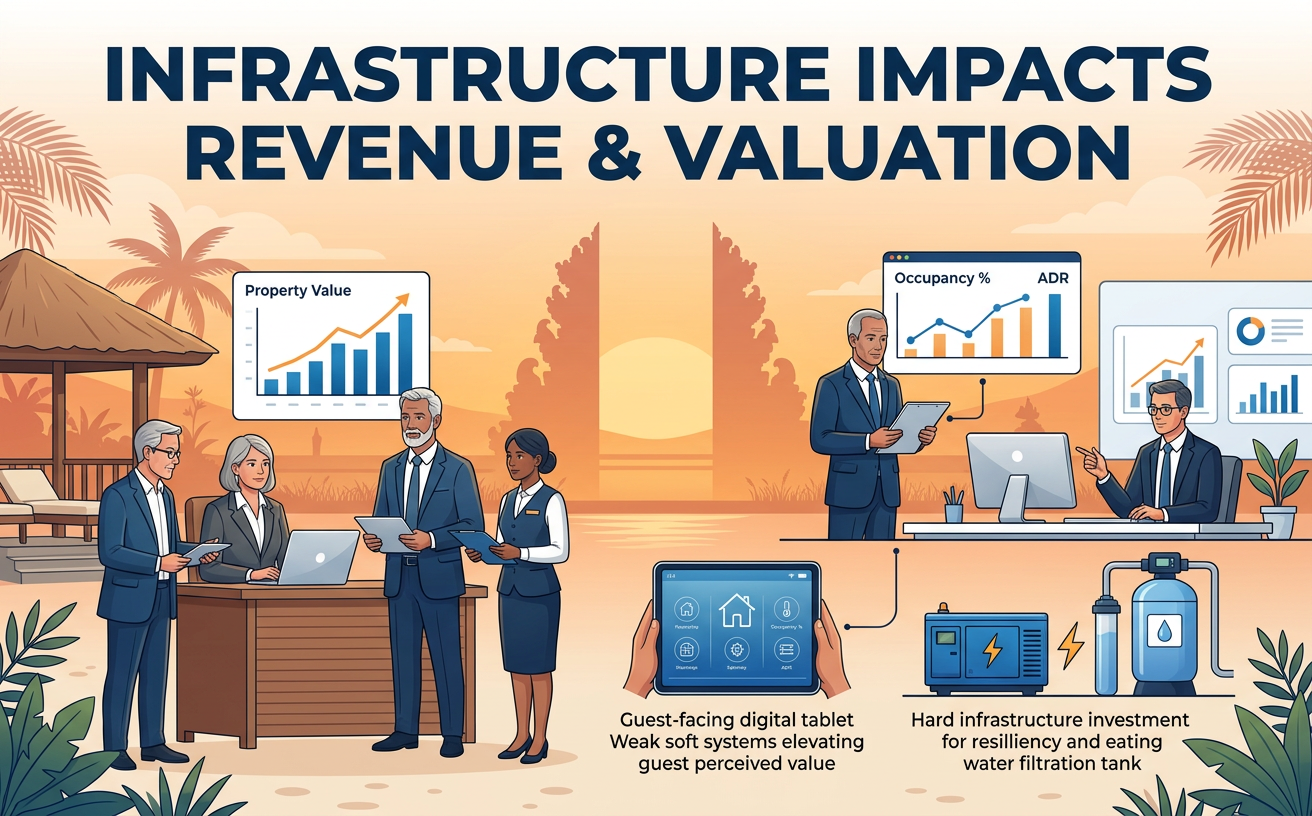
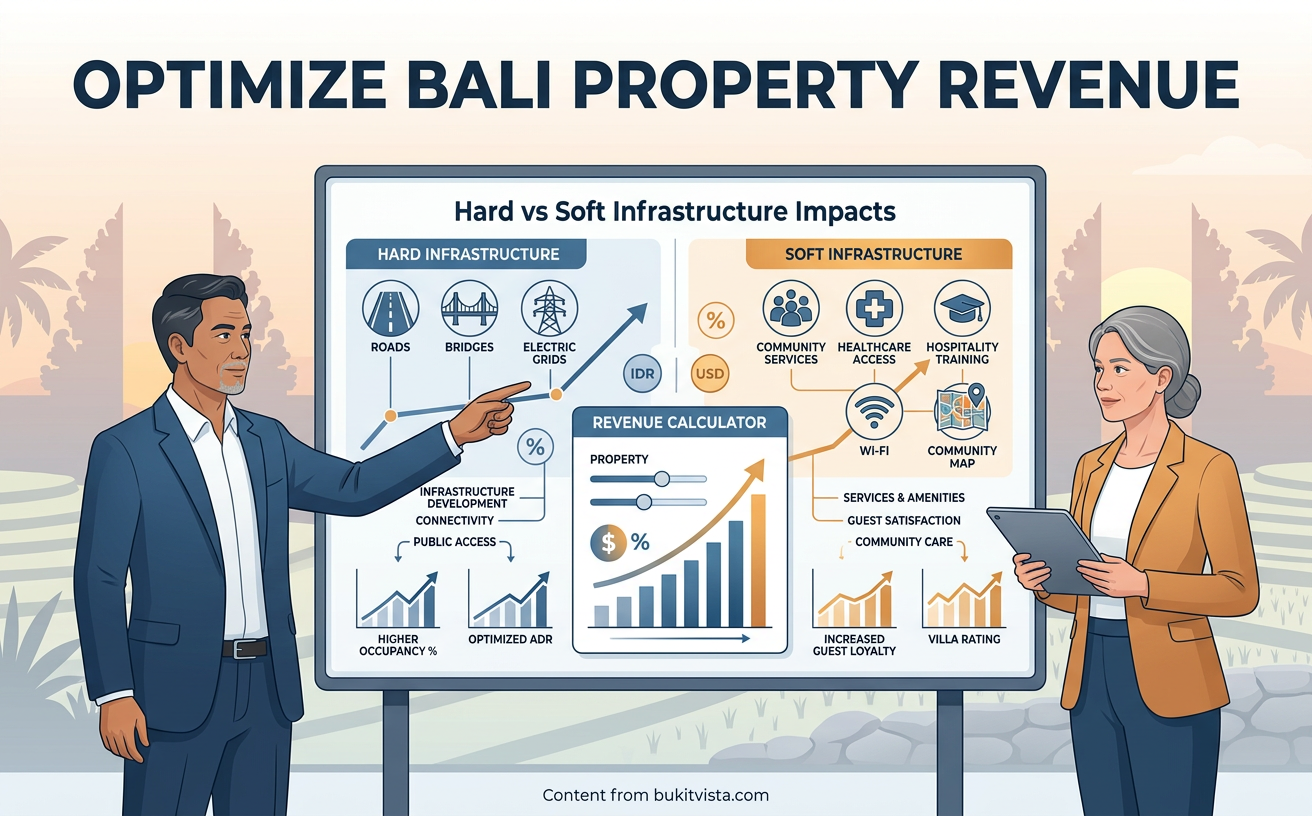
The interaction between hard and soft infrastructure determines performance levers for properties: occupancy, ADR, ancillary spend, and operating cost structure. Reliable hard infrastructure reduces variable costs and guest friction, while strong soft systems elevate perceived value, allowing for higher ADRs and better guest retention. Together, they shift both short-term cash flows and longer-term valuation multiples used by investors and management companies.
Empirical indicators to watch include booking lead times, length-of-stay patterns, cancellation rates linked to transport or utility issues, and review sentiment referencing service quality. Aligning property investments—such as on-site water treatment, staff training, and smart home systems—with public infrastructure gaps can protect margins and create differentiation in crowded segments.
Tactical actions for property owners
- Benchmark ADR and occupancy against regions with comparable infrastructure levels
- Invest selectively in on-site resiliency (generators, water storage) where public supply is unreliable
- Prioritize staff training and guest-facing systems to capture ADR premiums
What Could Your Bali Villa Really Earn?
Strategies to Balance Hard and Soft Infrastructure for Maximum ROI
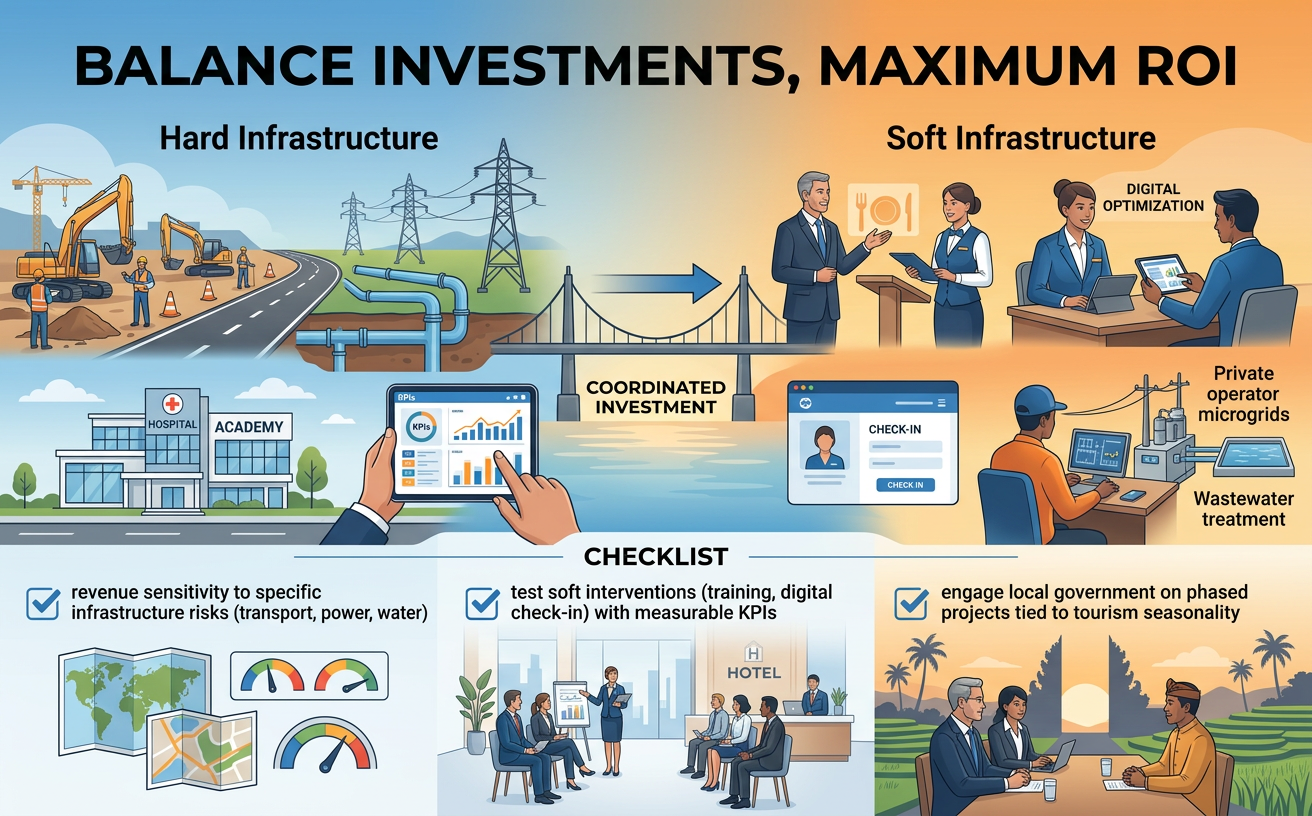
Optimal returns come from coordinated investments: pairing targeted hard upgrades (access improvements, utilities) with soft investments (training, permitting navigation, digitalization). Public-private partnerships can accelerate returns by aligning municipal projects with tourism demand windows, while private operators can pilot scalable solutions—microgrids, wastewater treatment, hospitality academies—that reduce dependency on slow-moving public works. A portfolio approach that prioritizes resilience and guest experience tends to outperform pure asset-heavy strategies.
For policy-makers and investors, sequencing matters: prioritize fixes that reduce recurring operating costs and enable premium services, then scale visible hard projects that unlock broader visitation growth. Monitoring KPIs across both domains ensures investments are delivering expected revenue uplift rather than merely increasing sunk costs.
Checklist for investors and managers
- Map revenue sensitivity to specific infrastructure risks (transport, power, water)
- Test soft interventions (training, digital check-in) with measurable KPIs before scaling
- Engage local government on phased infrastructure projects tied to tourism seasonality
SEO Recommendations: Title, URL, and Meta Description
To maximize discoverability for property owners and investors researching infrastructure impacts in Bali, use a concise title and meta that target transactional and informational queries. The suggested assets below are tailored for search intent around “Bali property performance,” “infrastructure Bali,” and “villa revenue calculator.”
Suggested SEO elements
- Title: Hard vs Soft Infrastructure in Bali — What Drives Villa Revenue and Occupancy
- URL slug: /hard-vs-soft-infrastructure-bali-property-performance
- Meta description: Explore how Bali’s hard and soft infrastructure affect villa occupancy, ADR, and revenue. Practical strategies for owners and investors plus a free revenue calculator to estimate your property’s potential.
Key Takeaways
- Both hard and soft infrastructure materially affect occupancy, ADR, and long-term property valuation; ignoring either reduces ROI.
- Prioritize investments that lower operating costs and improve guest experience—on-site resiliency and staff training yield rapid, measurable gains.
- Public-private coordination accelerates impact; operators should map revenue sensitivity to infrastructure risks and engage local authorities.
- Use data-driven tools, like a revenue calculator, to benchmark potential uplift before committing capital.
Final word: the path to stronger property performance in Bali requires a balanced, data-led approach to infrastructure. Owners and investors who align selective hard upgrades with scalable soft investments will capture the largest, most sustainable revenue gains. For practical benchmarking, owners can use an independent revenue projection tool to quantify upside and prioritize intervention areas.
Jason, Business Journalist at Bukit Vista
You’re a property owner? Wondering What Could Your Bali Villa Really Earn?
Get a data-driven revenue projection based on your property type, area, and bedroom count. Discover your villa’s true earning potential in Bali.