

Lombok vs Bali: Which Island Delivers the Better Property Investment in 2026?
We are unpacking content from Bali Business Review on YouTube to compare Lombok and Bali as property investments. This report focuses on recent demand trends, pricing trajectories, occupancy and yield indicators, and short-term versus long-term profitability signals. The analysis highlights where rental returns and capital appreciation are converging or diverging between the islands. Investors get a concise data-driven framework to decide which market aligns with their risk-return objectives.
Hi, I’m Jason, a Business Journalist at Bukit Vista, and I’ll be unpacking analysis from Bali Business Review. Today, we’ll dive into Lombok vs Bali: The Smarter Investment? to offer clear, data-driven insights.
Market Overview: Supply, Demand and Positioning

Bali remains the region’s established tourism hub with a diversified demand base across leisure, digital nomads and high-end short-stay travelers, while Lombok is positioned as an emerging alternative with lower base pricing and targeted development. Bali’s inventory includes many professionally managed villas and hotels that support higher average daily rates, whereas Lombok’s supply is still catching up with fewer managed units and a larger share of owner-operated properties. The practical implication for investors is that Bali offers immediate scale and cashflow predictability, while Lombok presents opportunities for land appreciation and higher entry-rate growth if infrastructure and demand accelerate.
Market overview checklist
- Demand diversity: Bali = broad, Lombok = growing leisure focus
- Supply maturity: Bali = mature professionally managed inventory, Lombok = nascent supply
- Positioning: Bali = established premium market, Lombok = value & growth play
What Could Your Bali Villa Really Earn?
Demand Drivers and Occupancy Dynamics
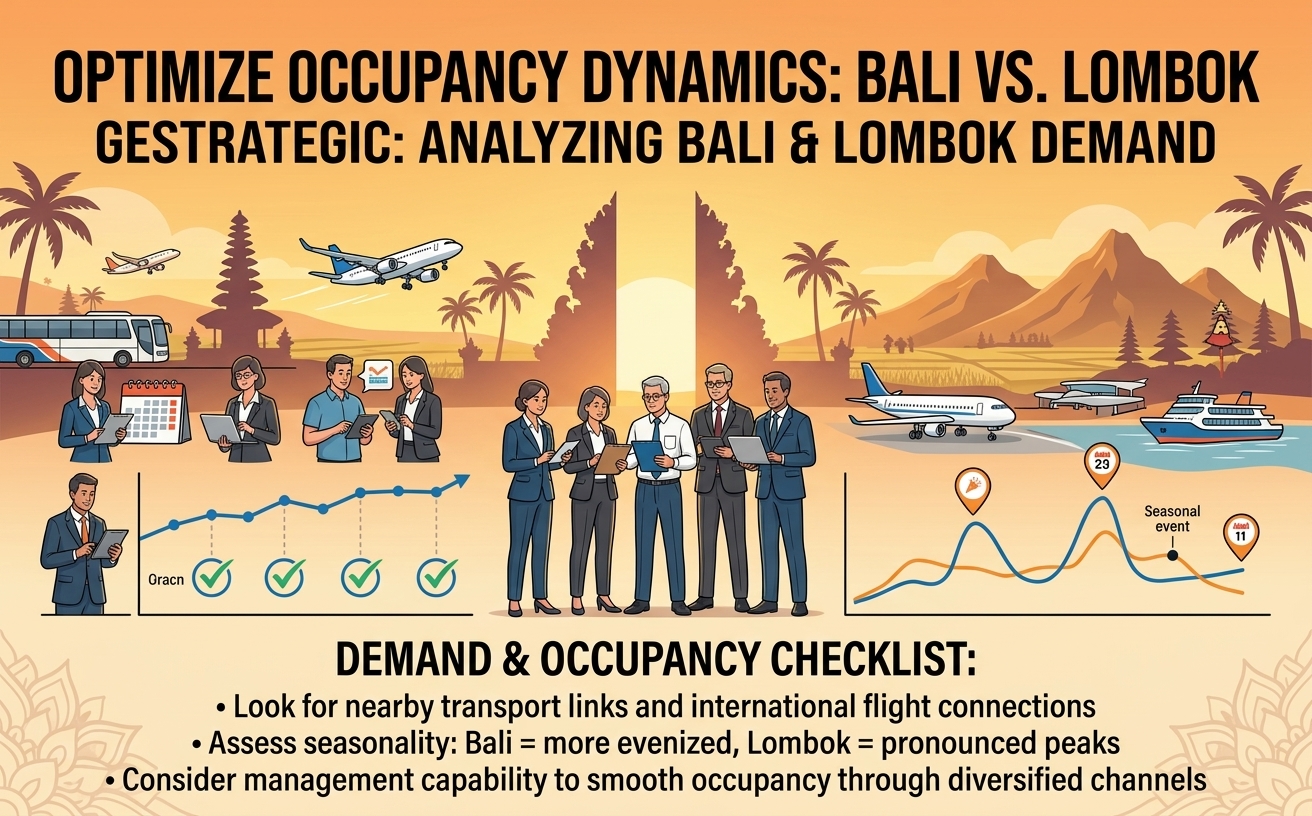
Occupancy patterns differ: Bali typically posts higher year-round occupancy due to established international routes and repeat visitation, while Lombok shows strong seasonal spikes tied to specific attractions and new flight connections. The practicality for investors is to expect steadier rental income in Bali and potentially higher but less predictable occupancy in Lombok. For projects near new infrastructure—airports, ferries, or resort nodes—Lombok can yield rapid uplift in guests, but that uplift hinges on sustained connectivity and marketing to source markets.
Demand and occupancy checklist
- Look for nearby transport links and international flight connections
- Assess seasonality: Bali = more evenized, Lombok = pronounced peaks
- Consider management capability to smooth occupancy through diversified channels
Pricing, Yields and Profitability Comparison
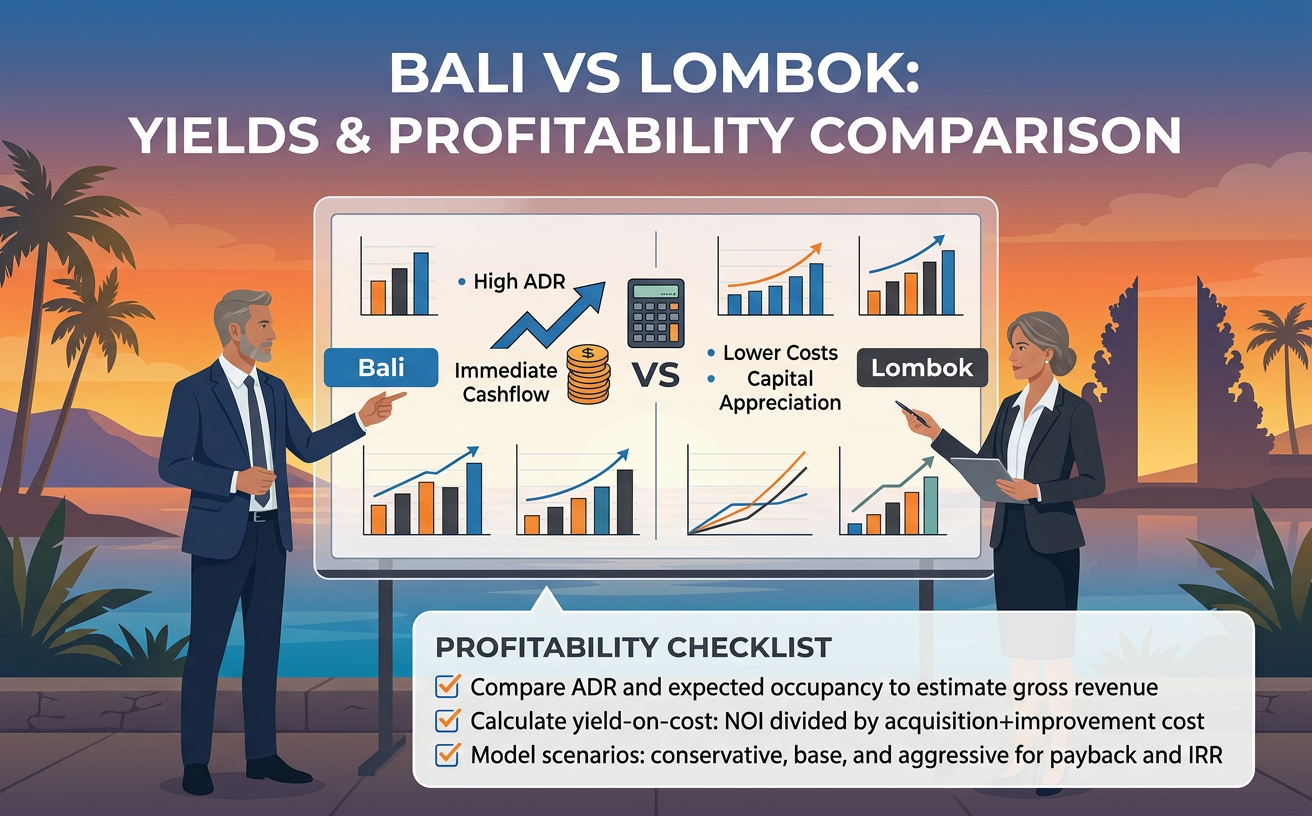
Bali typically commands higher tariffs per night, translating to stronger near-term revenue per property when professionally managed, while Lombok’s lower acquisition costs can produce attractive yield-on-cost metrics if operators can realize modest occupancy and ADR growth. From a return perspective, Bali favors investors prioritizing immediate cashflow and lower marketing burden, whereas Lombok may suit investors targeting capital appreciation and value-add repositioning. Use net operating income and yield-on-cost calculations to compare: insert conservative occupancy and ADR assumptions for both islands and run scenarios to assess payback timelines and IRR sensitivity.
Profitability checklist
- Compare ADR and expected occupancy to estimate gross revenue
- Calculate yield-on-cost: NOI divided by acquisition+improvement cost
- Model scenarios: conservative, base, and aggressive for payback and IRR
Risks, Regulations and Development Factors
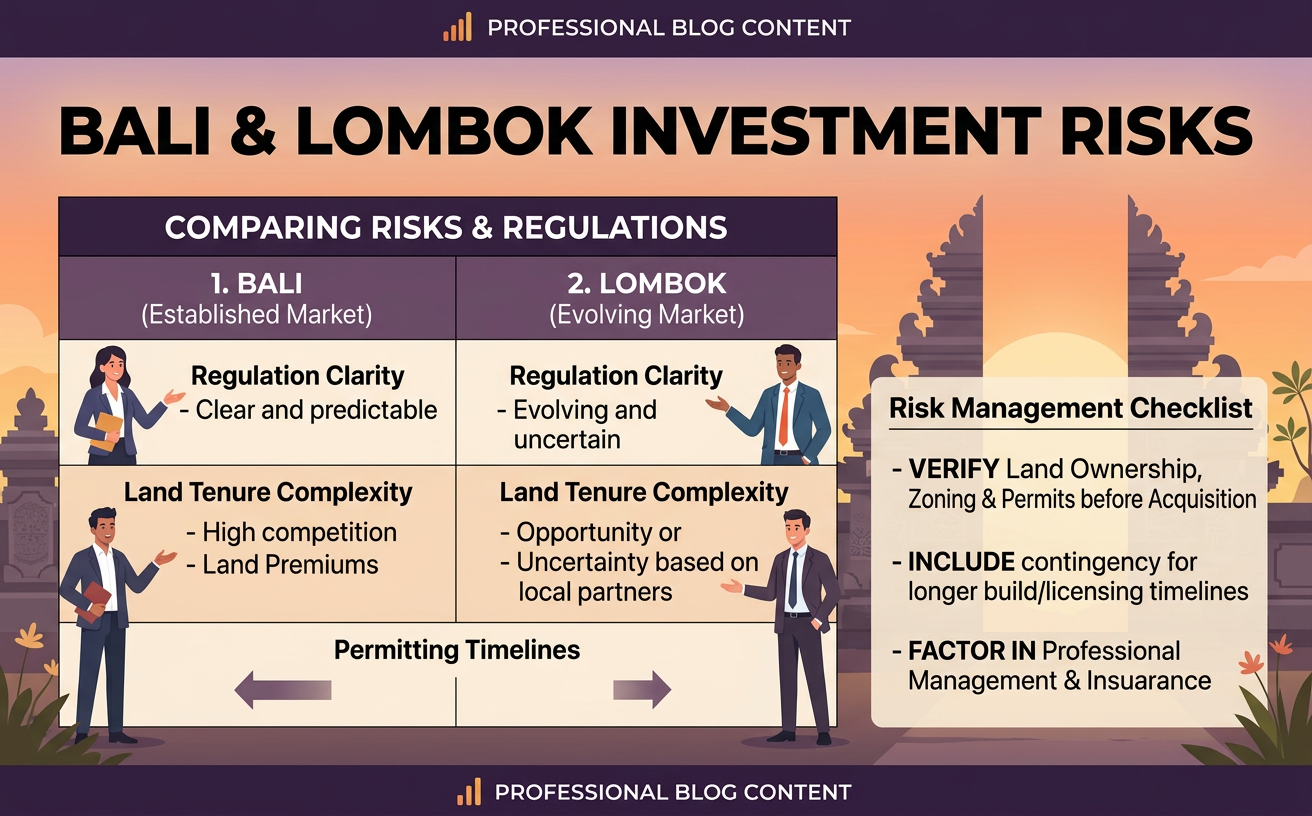
Regulatory clarity, land tenure complexity and permitting timelines differ between the islands and materially affect time-to-market and holding costs. Bali’s established regulatory environment reduces execution risk for established operators but can mean higher competition and land premiums; Lombok’s evolving framework presents both opportunity and uncertainty depending on local governance and developer relationships. Investors should conduct on-the-ground legal due diligence, confirm land titles and consider local partnership models to mitigate administrative and operational risks.
Risk management checklist
- Verify land ownership, zoning and permit status before acquisition
- Include contingency for longer build or licensing timelines
- Factor in professional management and insurance to protect revenue streams
Practical Investment Strategy and Action Steps
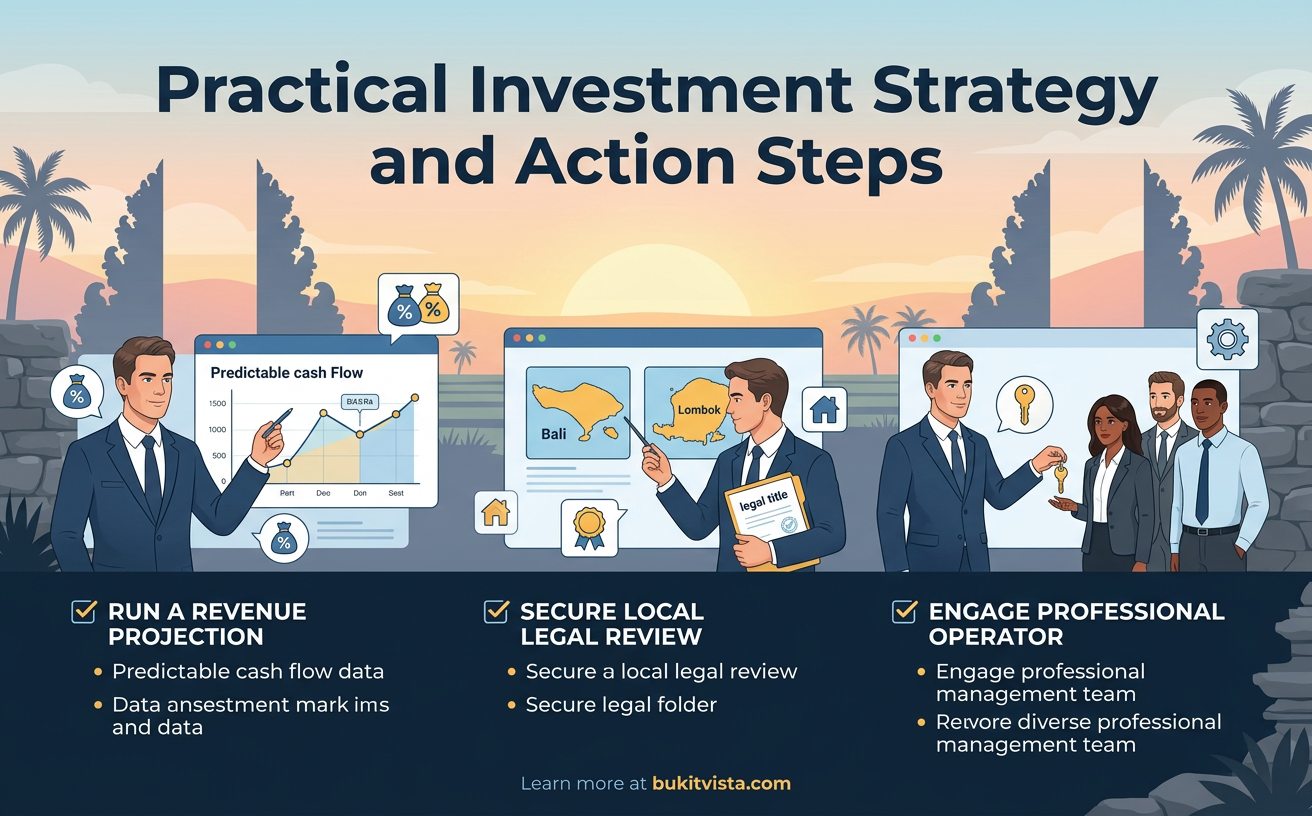
Decide based on your priorities: choose Bali if you need immediate, more predictable rental cashflow and professional management scale; choose Lombok if you accept higher execution risk for lower entry cost and potential upside from infrastructure-led growth. For both markets, stress-test projections with conservative occupancy and ADR, and prioritize double-checked legal titles and a management partner with proven distribution reach. Use a revenue projection tool to convert market assumptions into clear monthly and annual revenue forecasts to compare net returns side-by-side.
Action checklist
- Run a revenue projection for both islands using conservative inputs
- Secure local legal review and align on land/title structure
- Engage a professional operator for go-to-market and channel management
Key Takeaways
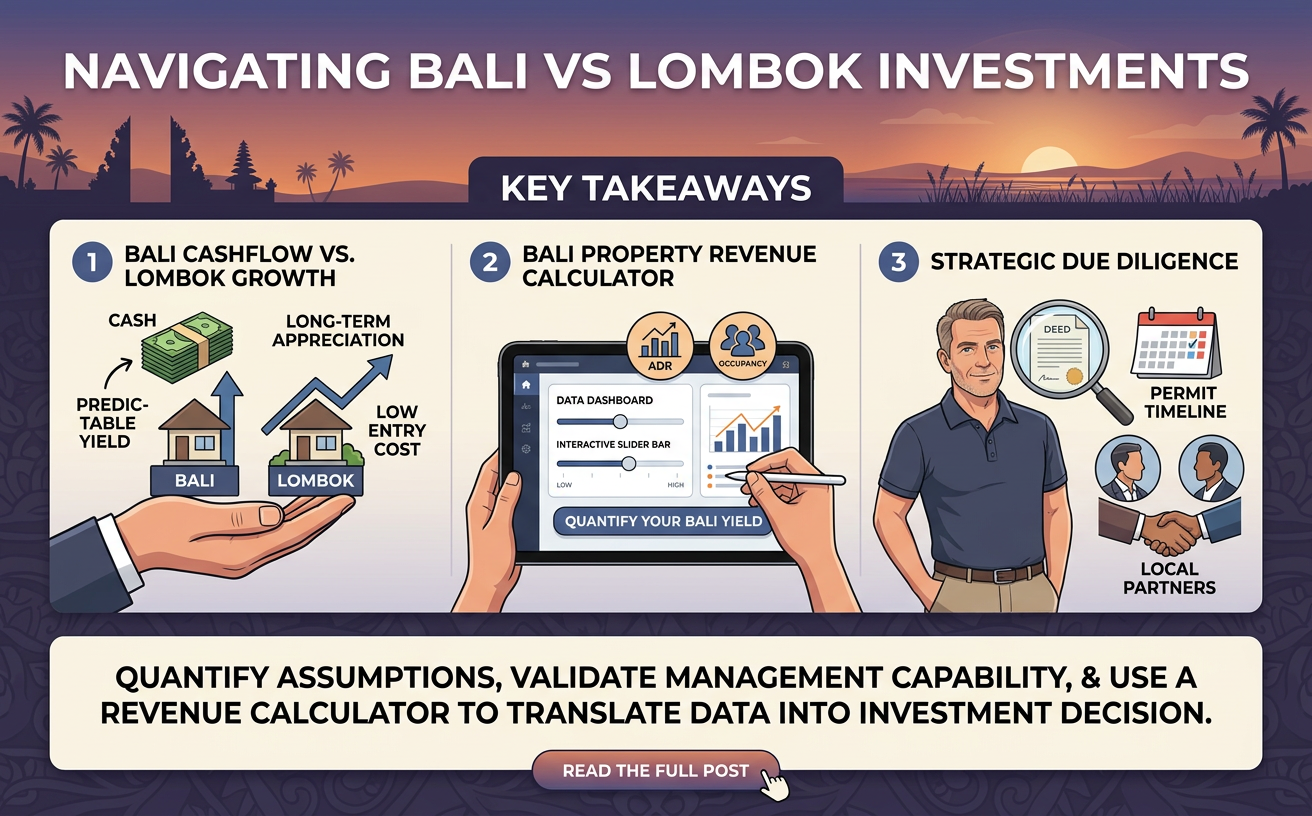
- Immediate cashflow vs. growth trade-off: Bali delivers steadier income today; Lombok offers potential appreciation at lower entry cost.
- Model scenarios: Run conservative, base and aggressive revenue scenarios to compare IRR and payback timelines before committing.
- Due diligence: Title verification, permitting timelines and local partnerships are decisive factors for execution risk.
- Use tools: Leverage the Bali Property Revenue Calculator to quantify expected earnings under realistic occupancy and ADR assumptions.
Final word: both islands can be smart investments when aligned to an investor’s time horizon and risk tolerance. Bali is the choice for investors prioritizing predictable rental yields and operational scale, while Lombok rewards patient capital that can execute on value-add or land appreciation plays. Quantify assumptions, validate titles and management capability, and use a revenue calculator to translate market data into a clear investment decision.
You’re a property owner? Wondering What Could Your Bali Villa Really Earn?
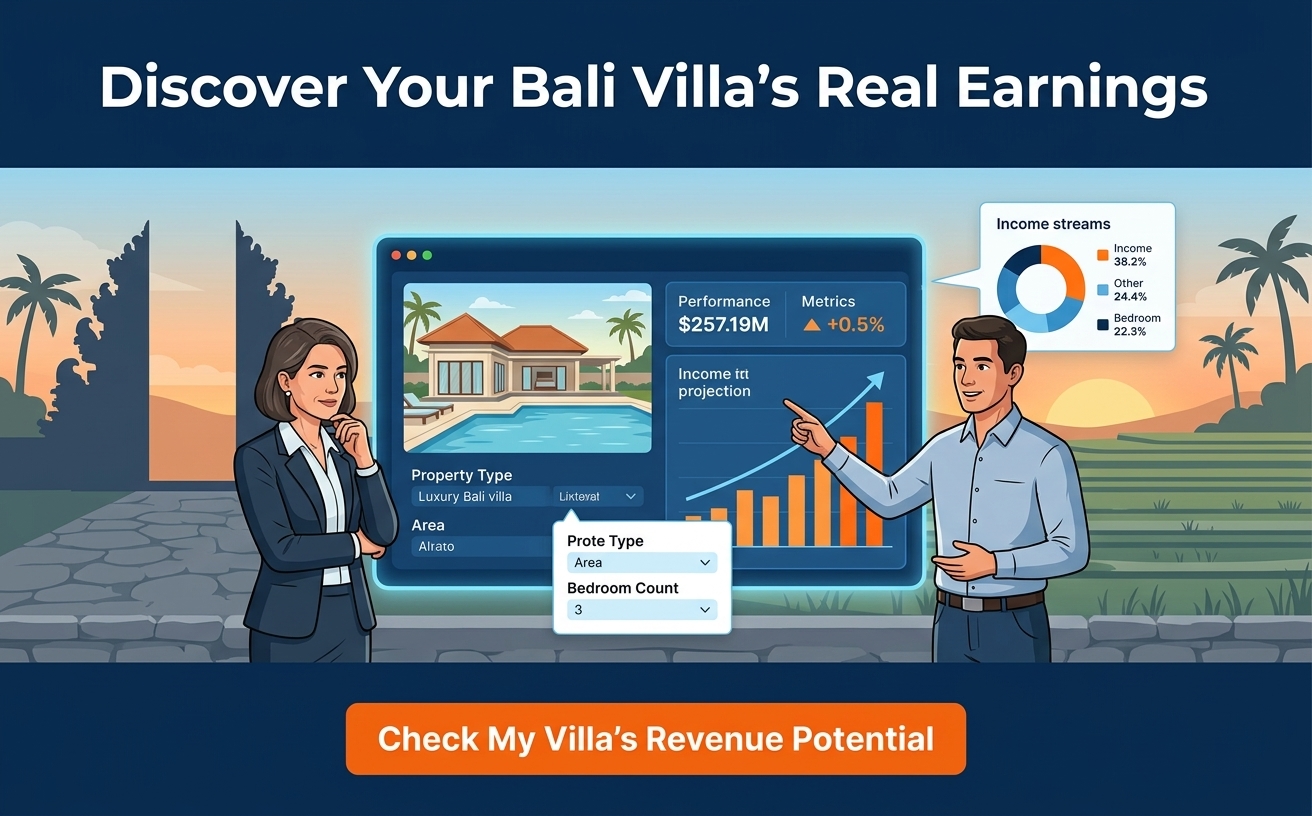
Get a data-driven revenue projection based on your property type, area, and bedroom count. Discover your villa’s true earning potential in Bali.
Jason, Business Journalist at Bukit Vista