


The Real Truth Behind Off-Plan Bali Villa ROI: Canggu 2-Bedroom Breakdown
Unpacking content from Bali Business Review on YouTube, this report examines off-plan villa ROI in Bali with a focused case: a modern 2-bedroom in Canggu listed at 4.2 billion IDR with a projected 11.5% gross ROI. We highlight the headline numbers and the critical adjustments investors must model.
Hi, I’m Jason, a Business Journalist at Bukit Vista, and I’ll be unpacking analysis from Bali Business Review. Today, we’ll dive into off-plan villa ROI in Bali (Canggu example) to offer clear, data-driven insights.
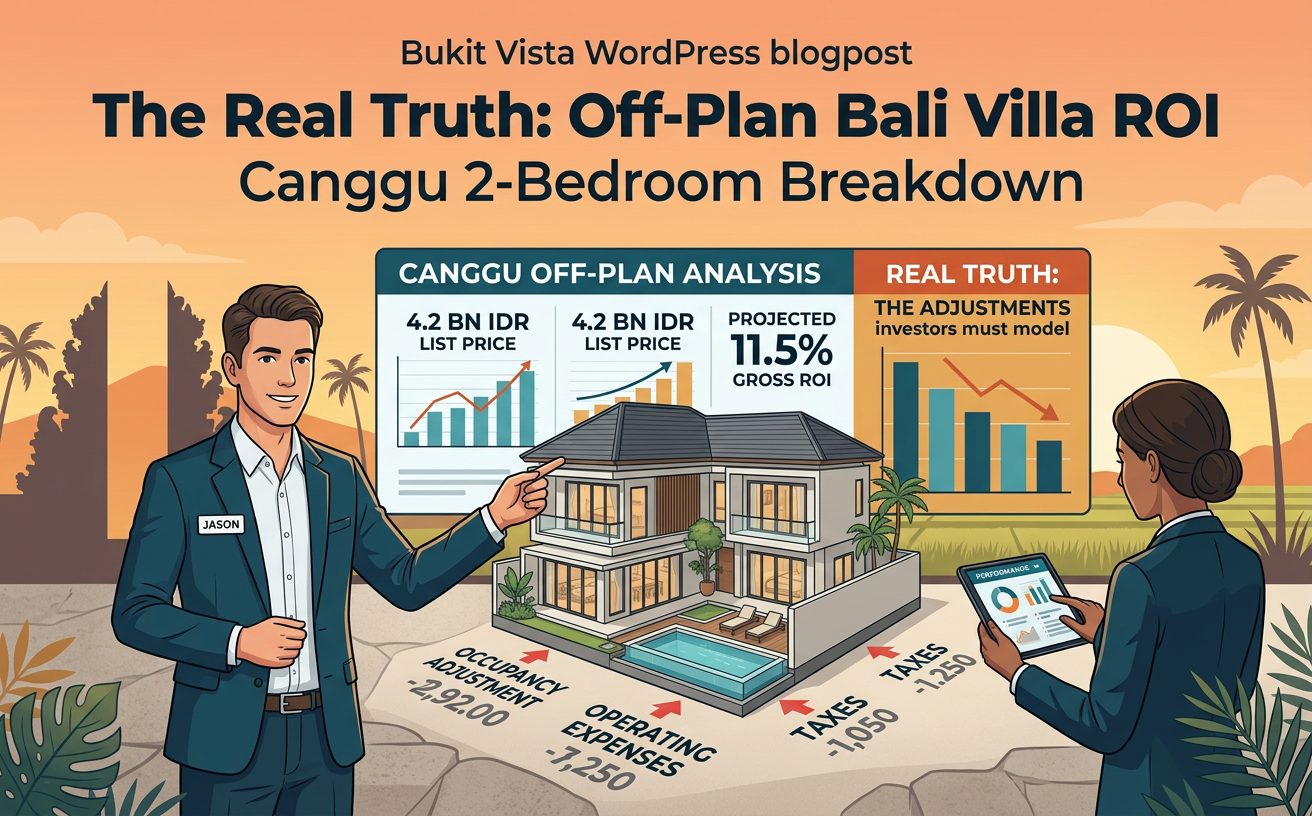
What Could Your Bali Villa Really Earn?
What Off-Plan Villas Are and Why Investors Find Them Attractive
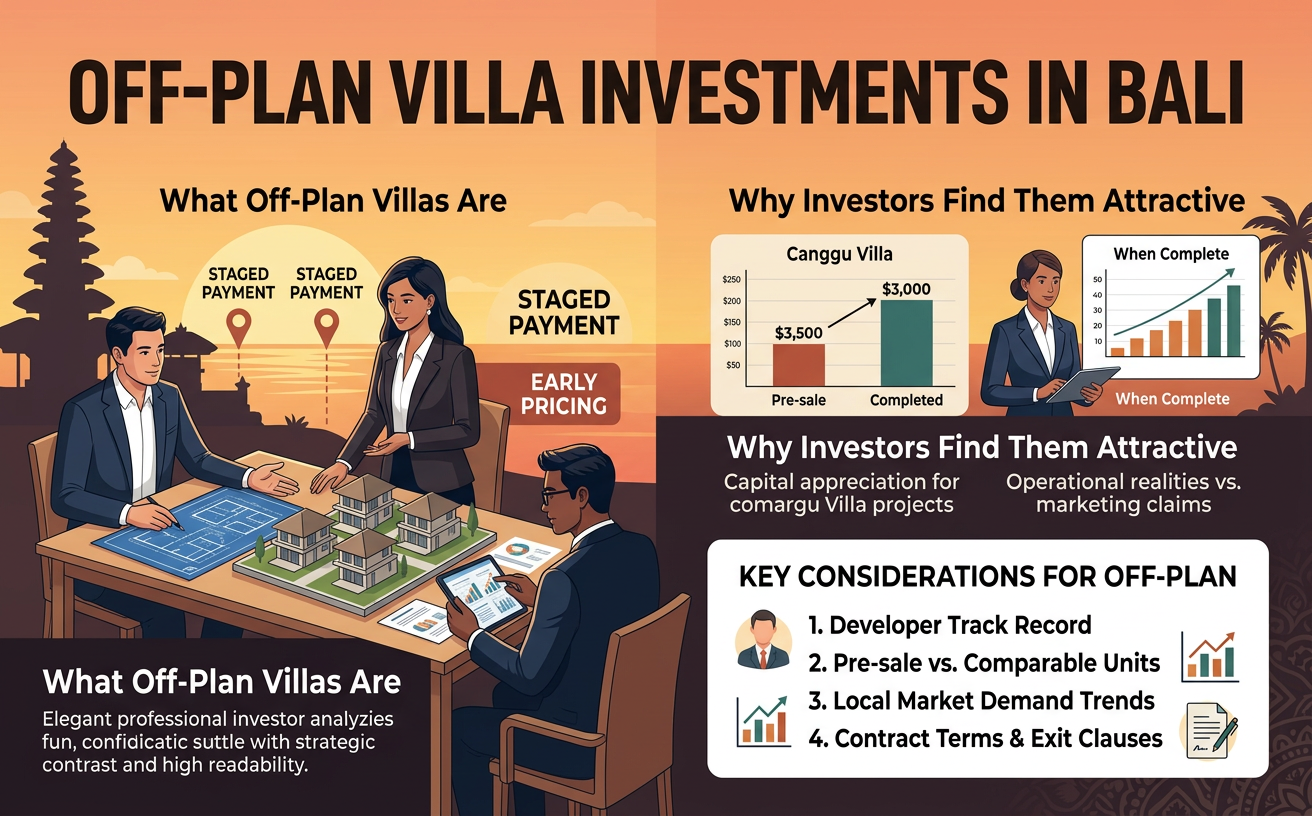
Off-plan villas are properties sold prior to completion, often at a price that reflects construction timelines and market expectations. Investors are attracted to off-plan opportunities because they can secure favorable pricing, staged payment schedules, and the potential for capital appreciation by completion—especially in high-demand areas like Canggu. Developers frequently market attractive projected yields or rental guarantees to capture investor interest, but those headline figures rarely account for post-completion operational realities.
Understanding the product means separating marketing claims from quantifiable assumptions: the developer’s price, construction timeline, local demand forecasts, and how the property will be managed and marketed once operational. Treating off-plan opportunities as speculative until validated by independent appraisal and a conservative operating forecast reduces capital risk and aligns expectations with real-world returns.
Key considerations for evaluating off-plan offers
- Developer track record and delivery timelines.
- Pre-sale pricing vs. comparable completed units.
- Local market demand trends and seasonality.
- Contract terms, payment schedule, and exit clauses.
Canggu 2-Bedroom Example: Price and Projected Gross ROI Explained
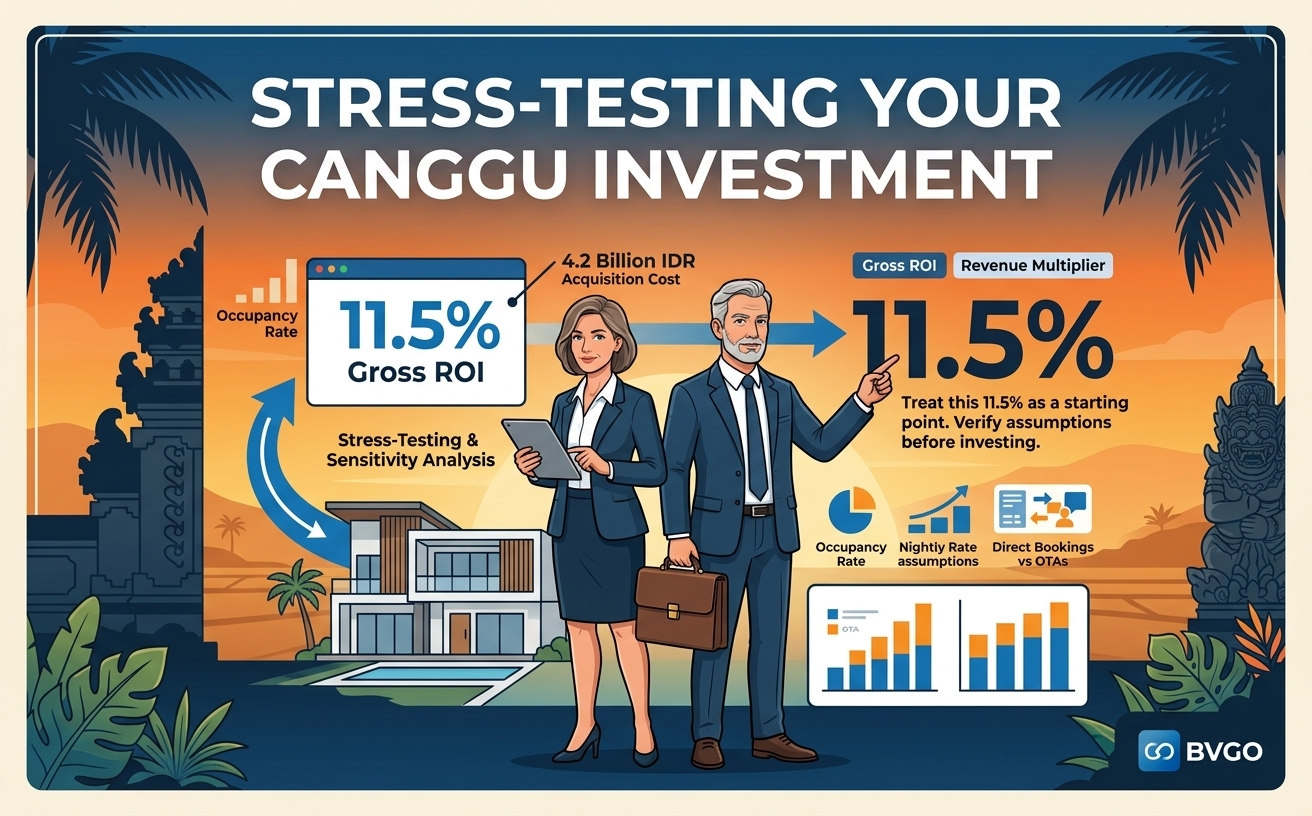
The illustrative case uses a modern 2-bedroom tropical villa in Canggu priced at 4.2 billion IDR with a projected gross ROI of 11.5%. This gross ROI typically represents rental revenue divided by acquisition cost before operational deductions. While 11.5% gross is headline-grabbing, it should be treated as a starting point for deeper stress-testing against realistic occupancy rates and nightly rate assumptions for Canggu’s market segment.
Investors should request the assumptions behind the projection: assumed occupancy, average daily rate, seasonal adjustments, and the revenue split between direct bookings and OTAs. Comparing the developer’s revenue model against independent short-term rental comps in Canggu will reveal whether the 11.5% figure is aggressive, conservative, or reasonable given current demand, competition, and pricing dynamics.
Practical follow-ups for this example
- Obtain the detailed revenue model and occupancy assumptions used to calculate the 11.5% gross ROI.
- Compare projected ADR and occupancy to recent market comps in Canggu for the same property class.
- Run a sensitivity analysis for lower occupancy and ADR scenarios to estimate downside ROI.
Operational Costs, Taxes, Management Fees and OTA Cuts: Measuring True ROI
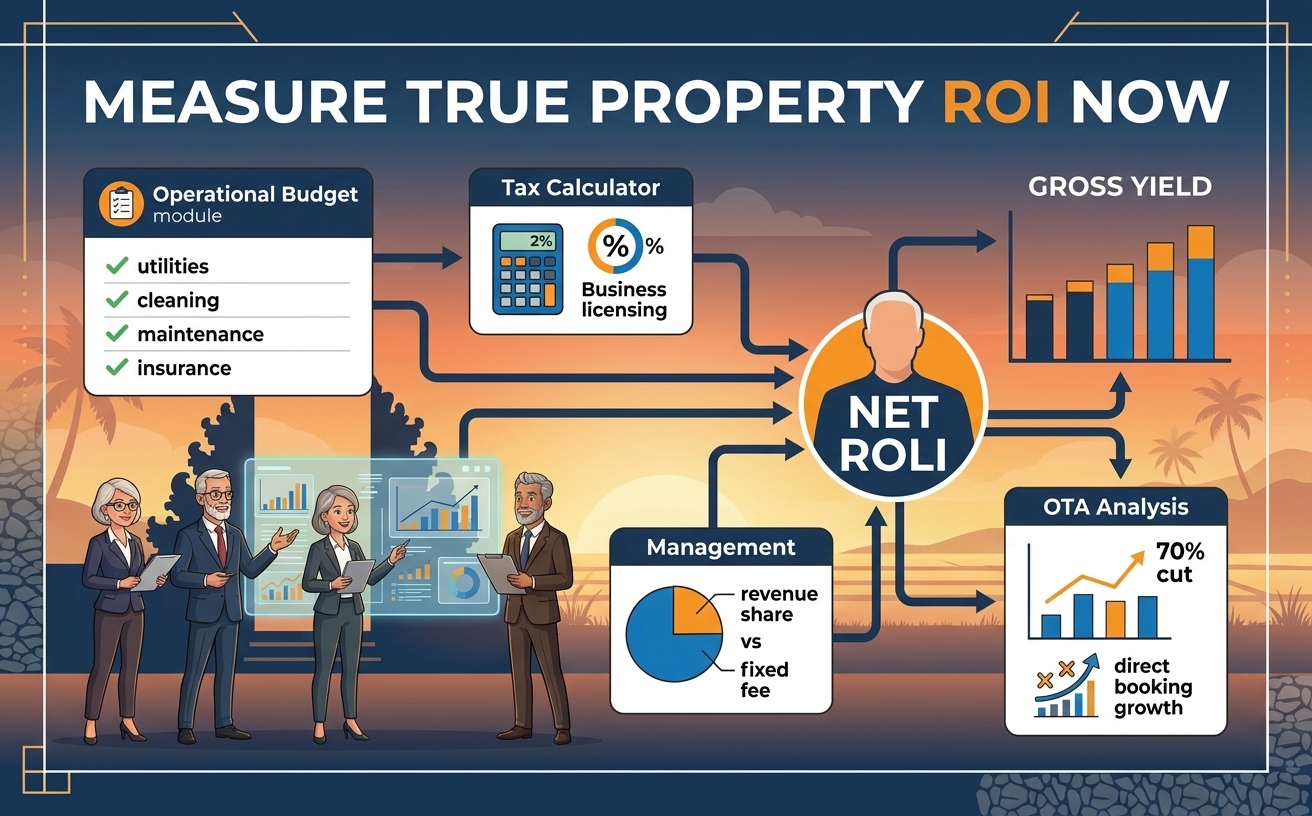
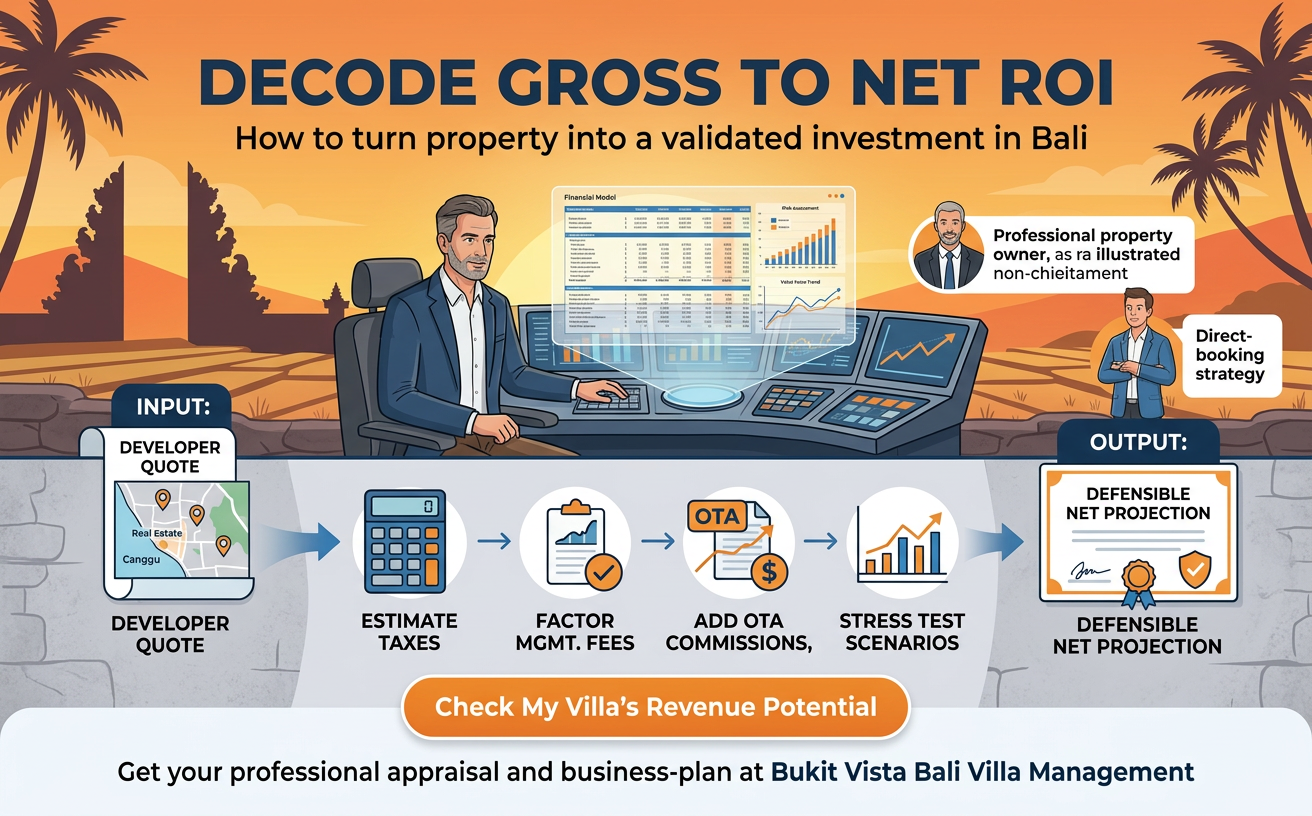
Gross ROI excludes key expense lines that materially reduce investor returns; converting gross into net ROI requires evaluating operational costs, local taxes, management fees, and OTA commissions. Operational costs include utilities, routine maintenance, staffing, insurance, and periodic refurbishment—all recurring drains on cash flow that must be forecasted prudently. Local taxes and mandatory fees, along with business licensing or tourism levies, further reduce distributable income.
Management fees and OTA commissions are particularly impactful for short-term rental models: professional property managers typically charge a percentage of gross revenue for full-service hospitality operations, and online travel agencies commonly take another percentage for bookings. When combined, these service fees can convert an 11.5% gross yield into a substantially lower net return unless the investor secures strong direct-booking strategies or negotiates favorable management terms.
Expense checklist to convert gross to net ROI
- Line-item operating budget: utilities, cleaning, maintenance, insurance.
- Local taxes and licensing costs applicable to villa rentals.
- Management fee structure: revenue share vs fixed fee and included services.
- OTA commission rates and direct-booking strategy to reduce reliance on third parties.
Why Professional Appraisals and Business Plans Are Non-Negotiable

A professional appraisal provides an independent valuation that anchors purchase price decisions to market realities rather than promotional pricing. Likewise, a detailed business plan and pro forma financial model translate headline ROI into a multi-year cashflow forecast, incorporating conservative assumptions, capital expenditure schedules, and contingency buffers. These documents help investors quantify risk, test sensitivity to occupancy and rate fluctuations, and create an exit strategy aligned with liquidity goals.
Beyond valuation and forecasts, legal due diligence is essential: clear land title, permitted land use, and compliance with local regulations can materially affect both cost and the ability to operate. Engaging experienced valuers, hospitality operators, and legal counsel before committing capital preserves upside while mitigating avoidable operational, regulatory, and market risks that can erode expected returns.
Due diligence checklist before acquisition
- Independent market valuation and comparable completed sales.
- Detailed multi-year pro forma with sensitivity analysis.
- Legal review of title, permits, and local zoning or tourism regulations.
- Operational transition plan including management agreements and marketing strategy.
Key Takeaways
- Headline gross ROI (11.5% on the Canggu 2-bed example) is a useful starting metric but not a final investment decision driver.
- Convert gross to net ROI by modeling operational costs, taxes, management fees, and OTA commissions conservatively.
- Insist on independent appraisals and a detailed business plan with multi-scenario stress tests before committing capital.
- Compare developer assumptions to real market comps in Canggu and prioritize direct-booking strategies to protect net yield.
- For appraisal and business-plan support, leverage resources at Bukit Vista to align assumptions with market realities.
Final word: off-plan villas can deliver attractive returns, but realizing that promise requires rigorous financial modeling, independent valuation, and practical operational planning. Investors who convert headline gross yields into defensible net projections and secure professional advice position themselves to benefit from Bali’s tourism demand while managing downside risk. Full analysis and the underlying data are available at the embedded Bali Business Review link above and through Bukit Vista’s appraisal and planning services here.
Jason, Business Journalist at Bukit Vista
You’re a property owner? Wondering What Could Your Bali Villa Really Earn?
Get a data-driven revenue projection based on your property type, area, and bedroom count. Discover your villa’s true earning potential in Bali.