


The Tourist Trap Targeting Indian Travelers in Bali
Today’s report unpacks content from Bali Business Review on YouTube, highlighting how Indian travelers in Bali face economic pitfalls when approaching short-term rental investments. Key data points include occupancy trends, average nightly rates, and how inaccurate assumptions can produce negative ROI unless investors use verified market tools and proven revenue models.
Hi, I’m Jason, a Business Journalist at Bukit Vista, and I’ll be unpacking analysis from Bali Business Review. Today, we’ll dive into The Tourist Trap Targeting Indian Travelers in Bali to offer clear, data-driven insights.
Introduction to the topic

The piece explores why Indian travelers and first-time investors are particularly vulnerable to inflated expectations and financial traps in Bali’s villa market. Many buyers rely on anecdotal success stories or gross listing prices without adjusting for seasonality, fees, and realistic occupancy. The result is an overestimation of revenue that often translates into months of underperformance and, in some cases, negative returns on investment.
Contextual points
- Rapid tourism growth in Bali has attracted international buyers, increasing competition and complexity.
- Misleading short-term forecasts and broker optimism can obscure ongoing operational costs.
What Could Your Bali Villa Really Earn?
The significance of using real market data

Decisions based on verified market data—occupancy rates, ADR (average daily rate), and length-of-stay distributions—dramatically improve forecasting accuracy. Localized data reveals micro-market variations between areas like Seminyak, Canggu, and Ubud that blanket statistics miss. Investors who ground assumptions in current, granular metrics can set realistic revenue targets, identify off-season risk, and plan contingency cashflow buffers.
Why granular data matters
- Micro-market differences affect achievable nightly rates and demand windows.
- Accurate seasonality models prevent over-leveraging during low-demand months.
Function and benefits of the Bali Property Revenue Calculator
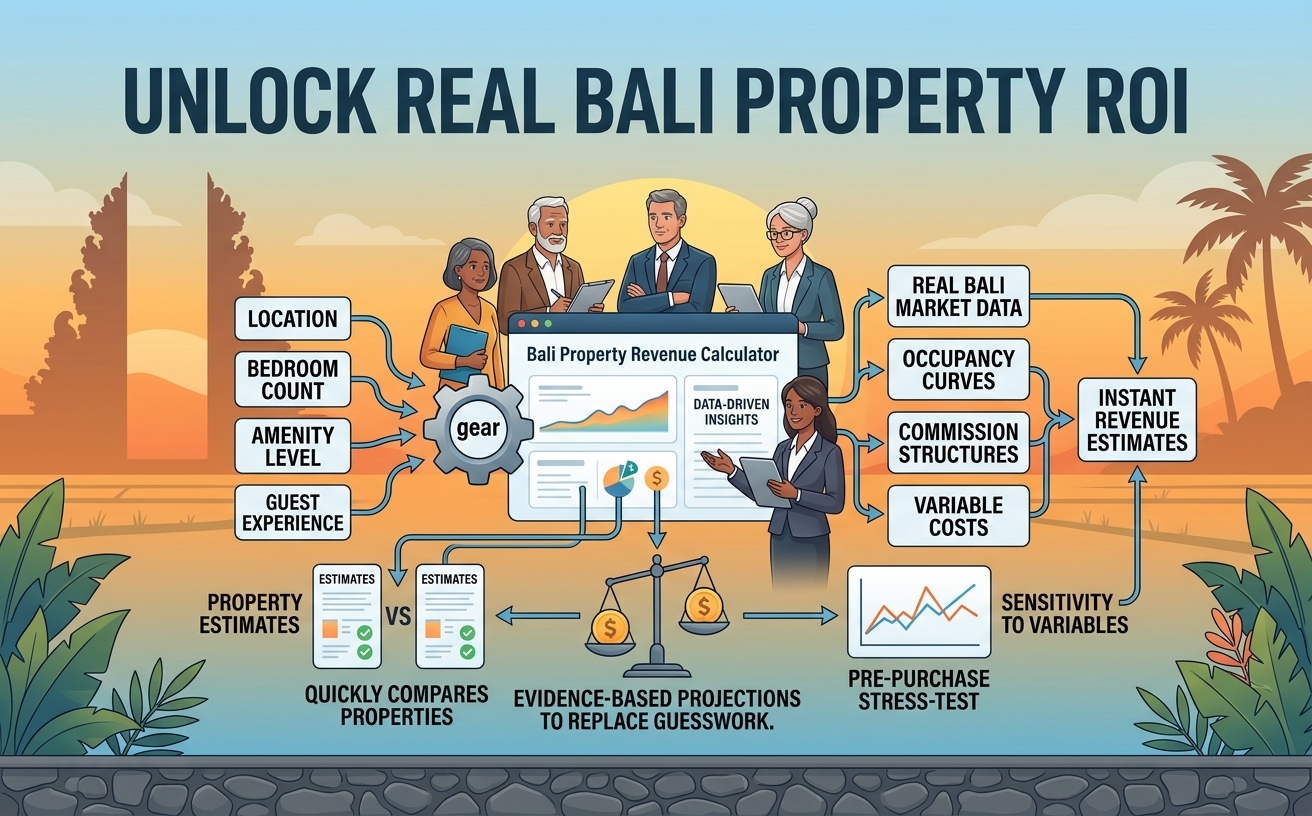
The Bali Property Revenue Calculator provides instant revenue estimates by combining real Bali market data with property-specific inputs like location, bedroom count, and amenity levels. It replaces guesswork with an evidence-based projection that accounts for occupancy curves, commission structures, and variable costs. For prospective buyers, the calculator acts as a pre-purchase stress-test to reveal realistic cashflow scenarios and break-even timelines.
Practical advantages
- Quickly compares multiple properties on equal terms, normalizing for seasonality and fees.
- Highlights sensitivity to variables (e.g., occupancy drops or increased maintenance costs).
Practical tips for avoiding negative ROI when investing in Bali
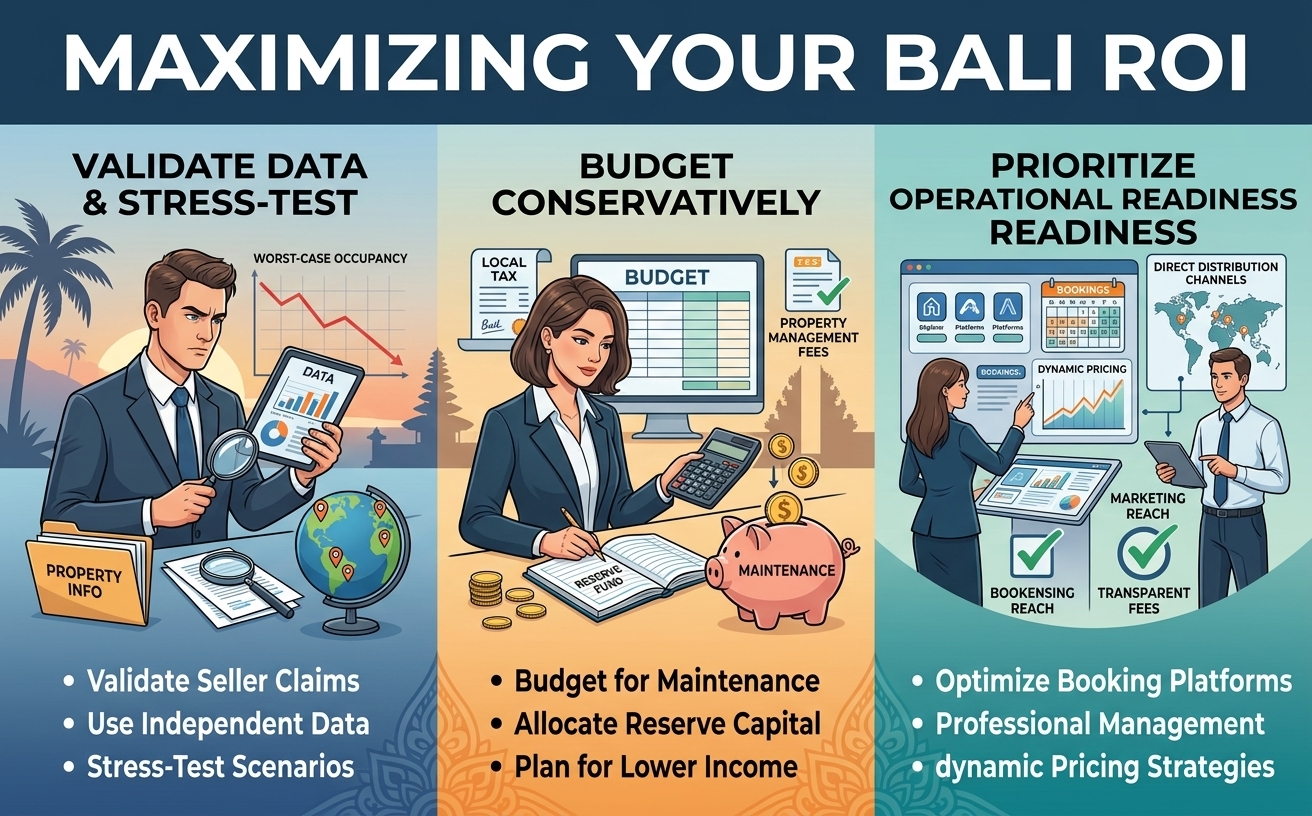
Avoid negative ROI by validating seller claims with independent data, stress-testing worst-case occupancy scenarios, and budgeting conservatively for maintenance, property management, and local taxes. Negotiate purchase terms with contingencies tied to verified revenue benchmarks rather than optimistic projections. Finally, prioritize operational readiness—professional management, dynamic pricing, and distribution strategies—to convert forecasted demand into realized bookings.
Checklist to protect returns
- Require demonstrable historical performance or run modelled projections using local data.
- Include buffer capital for 6–12 months of lower-than-expected income.
- Choose management partners with transparent fee structures and proven marketing reach.
See the full coverage on YouTube for additional insights

For a complete breakdown of model assumptions, case examples, and how inputs change outcomes, see the full coverage on YouTube by Bali Business Review. The extended analysis documents scenarios where small shifts in occupancy or pricing convert a profitable asset into a loss-making one, and shows how to rebalance strategies to preserve returns. Use their examples alongside the Bali Property Revenue Calculator to validate your own purchase decisions.
Follow-up actions
- Run your property through an evidence-based revenue tool before making an offer.
- Compare multiple scenarios and require contingency clauses in purchase agreements.
Key Takeaways
- Rely on localized, up-to-date market data to set realistic revenue expectations and protect against seasonal shocks.
- Use tools like the Bali Property Revenue Calculator to stress-test investments and reveal hidden costs.
- Budget conservatively, secure professional management, and include purchase contingencies tied to verified performance.
The business impact is clear: data-driven investment and conservative operational planning turn speculative purchases into sustainable revenue assets. Indian travelers and international buyers alike can avoid the tourist-trap pitfalls by applying disciplined modeling, independent verification, and choosing partners that prioritize transparency.
Jason, Business Journalist at Bukit Vista
You’re a property owner? Wondering What Could Your Bali Villa Really Earn?
Get a data-driven revenue projection based on your property type, area, and bedroom count. Discover your villa’s true earning potential in Bali.